Highlights from Sacred Destinations
Explore the site
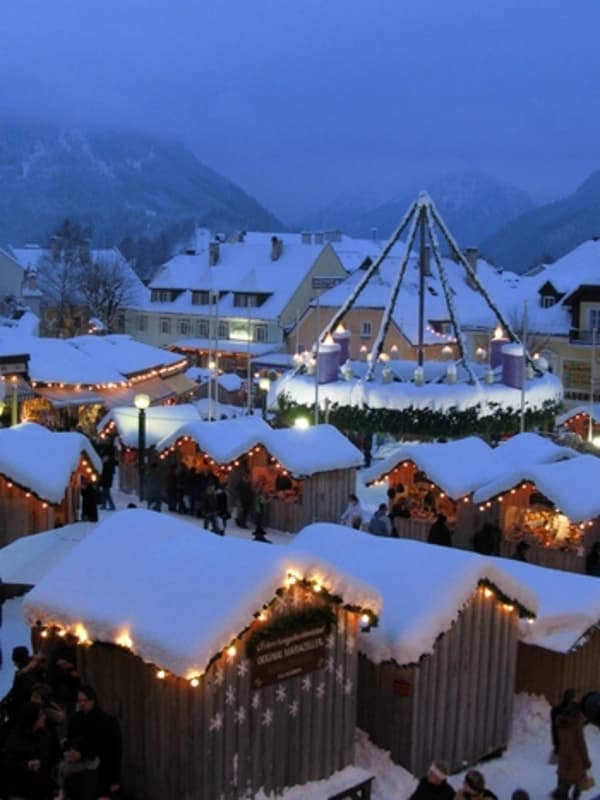
The basilica and shrine is located at the center of Mariazell, which is also a popular resort town, and its three west towers can be seen from around the city.
/ Austria / Mariazell Shrine
Virgin Mary · 1643 (basilica)
Nestled high in the Alpine mountains of Austria, the Shrine of Our Lady of Mariazell is the most popular Marian shrine in Central Europe. The shrine centers on a miraculous statue of the Virgin Mary discovered by a monk in 1157.
Nestled high in the Alpine mountains of Austria, the Shrine of Our Lady of Mariazell is the most-visited Marian shrine in Central Europe, receiving about a million pilgrims each year.
The area around present-day Mariazell was donated to the Monastery of St. Lambrecht in about 1103, after which monks began to build cells there. After that, legend takes over.
On the evening of December 21, 1157, a Benedictine monk named Magnus was in a forest looking for a place to build a monastery. At one point, his path became blocked by a huge boulder that was too big to go over or around, so Magnus took a small wooden statue of the Virgin Mary he had in his knapsack, knelt in prayer, and asked the Virgin Mary for guidance.
Soon there was a great rumble and the rock split in two, allowing him to pass through. Magnus placed the statue reverently on a white branch and soon after, he and some of the local people built a small chapel to house the statue. Word of the miraculous statue of the Virgin quickly spread across the countryside, and the chapel had to be periodically expanded to accommodate the growing crowds.
In 1200, the chapel was enlarged to a church and in 1335, Henry I expanded the church after experiencing a miraculous cure. Still more pilgrims began to visit after about 1330, when a Zellfahrt ("Zell journey") was introduced as a form of atonement for criminals.
In 1363, Louis I of Hungary replaced the church with an even larger one in thanksgiving for a victory. This Gothic church had a 90-meter-high spire with an ogive portal. In 1377, Louis I added the Chapel of Grace (Gnadenkappelle).
The Gothic church was expanded by Ferdinand III, and given the requisite Baroque makeover, in 1643. This is the church that still stands today. By 1699, almost 400,000 pilgrims flocked to the shrine of Our Lady of Mariazell each year. However, in 1783, Emperor Joseph II dissolved the Mariazell monastery in Mariazell, and in 1787, he completely banned pilgrimages there. The restrictions were later lifted.
To mark the 750th anniversary of the shrine's founding, Pope Pius X granted a plenary indulgence to those who visited Mariazell in 1907. The same year, the statue of Our Lady of Mariazell was crowned and the church was designated a Minor Basilica.
The first non-Austrian pilgrimages to Mariazell came from Hungary, followed soon after by Croatia, Slovakia, Bohemia, Germany, and other Central European countries. Our Lady of Mariazell came to be known by the titles "Great Mother of Austria, Great Lady of Hungary, and Great Mother of the Slavic People."
The Shrine of Mariazell celebrated its 800th anniversary in 1957 and Pope John Paul II visited on pilgrimage on September 13, 1983. Restorations have been underway since 1992. Today the shrine receives around a million pilgrims each year.
Lambrecht in about 1103 , after which monks began to build cells there.
On the evening of December 21, 1157 , a Benedictine monk named Magnus was in a forest looking for a place to build a monastery.
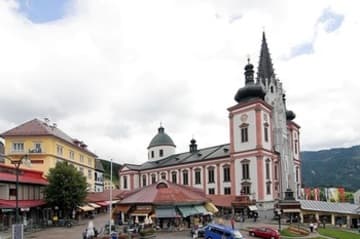
The basilica and shrine is located at the center of Mariazell, which is also a popular resort town, and its three west towers can be seen from around the city. The central tower is Gothic and was preserved from the 14th-century church; the two flanking Baroque towers were added in the 17th century. The Gothic portal with carved tympanum has also been preserved.
Inside, the miraculous statue is housed in the Lady Chapel or Chapel of Miracles, which stands directly over the place where Magnus established his monastic cell in 1157.
The statue is a small (48 cm tall) Romanesque wooden figure of the seated Virgin Mary holding the Christ Child. In the Baby's hands are an apple and a fig, calling to mind the Fall of Adam, but also Christ's redemption of mankind. Both Mary and Jesus are almost entirely covered in rich garments and wear golden, jewel-encrusted crowns.
Pilgrims who have received a blessing after praying to Our Lady of Mariazell leave ex-votos (gifts "out of thanks") at the shrine. As a testament to Mariazell's great popularity, the ex-votos represent one of the greatest numbers of nationalities of any Catholic shrine.
Highlights from Sacred Destinations
Highlights from Sacred Destinations
Advertisement
Advertisement
Advertisement
Where on earth