Highlights from Sacred Destinations
Explore the site
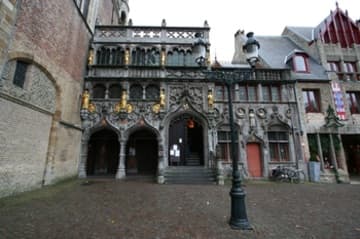
Snugly located in a back corner of Burg Square, the Basilica of the Holy Blood consists of a Romanesque lower chapel and a Gothic upper chapel.
/ Belgium / Basilica of the Holy Blood
Sacred site · 1150
This beautiful 12th-century basilica on Burg Square houses a very sacred relic - a vial said to contain the coagulated blood of Christ, collected at the crucifixion by Joseph of Arimathea.
The Basilica of the Holy Blood (Basiliek van het Heilig Bloed) in Bruges houses a venerated relic of Christ: his very blood, collected by Joseph of Arimathea.
The first historical record to mention the Holy Blood in Bruges dates from 1256. The real story seems to be that it came from Constantinople, which had an extensive collection of relics including one of the Holy Blood.
Constantinople was sacked by the Crusader army of Count of Flanders Baldwin IX in 1204, during the Fourth Crusade. Baldwin IX probably sent the Holy Blood, looted from the Byzantines, to Bruges shortly thereafter. The manner in which the rock-crystal vial is cut also suggests an origin in Constantinople.
Constantinople was sacked by the Crusader army of Count of Flanders Baldwin IX in 1204, during the Fourth Crusade.
The first historical record to mention the Holy Blood in Bruges dates from 1256.
Snugly located in a back corner of Burg Square, the Basilica of the Holy Blood consists of a Romanesque lower chapel and a Gothic upper chapel. The two levels could not be more different: the Romanesque lower level is austere with very little decoration, while the Gothic upper level is alive with color and detail.
The two chapels are connected by a monumental brick staircase, which runs behind the grand facade facing the square. The stairs and facade were built in 1533 in the Renaissance style, but demolished during the French occupation. They were rebuilt in the 19th century.
The gilded statues on the facade represent Archduchess Isabelle, Mary of Burgundy, and Derrick and Philip of Alsace. The medallions depict the Archdukes Albert and Maximilian of Austria, Margaret of York and Sybil of Anjou, wife of Derrick and mother of Philip of Alsace.
The lower chapel, the Chapel of St Basil, is the only Romanesque church in West Flanders, dating from the first half of the 12th century. It was built by Derrick, Count of Alsace (1128-1168) and dedicated to St Basil the Great to house a relic of the Greek theologian (d.379) brought back from Caesarea during the Crusades.
The chapel has a short nave, tiny side aisles, a choir and apse. The doorway connecting the right aisle with the nave has a small sculpted tympanum (12th century) depicting the baptism of St. Basil. The right aisle also contains a polychrome statue (c.1306) of the Madonna and Child, displayed behind glass.
Left of the choir is the Chapel of Saint Yves, added in 1504. It shelters the relics of Saint Basil as well as Charles the Good, the Count of Flanders who was assassinated. The black marble altarpiece is from the 16th century.
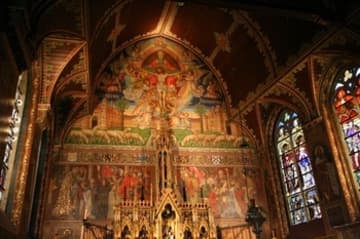
The upper chapel was originally Romanesque as well, but is now Gothic with mostly modern decoration. It is lit by stained glass windows and covered with murals, including a brightly painted altar backdrop depicting the Trinity and scenes relating to the Holy Blood relic.
The Holy Blood relic is embedded in a rock-crystal vial, which is placed inside a small glass cylinder capped with a golden crown at each end. The relic is kept in a magnificent silver tabernacle with a sculpture of the Lamb of God in the large side chapel of the upper church. The back wall of the side chapel displays ex-votos of those whose prayers before the Holy Blood have been answered.
More reliquaries can be seen in the Basilica Museum, including one created in 1617 by Bruges goldsmith Jan Crabbe, with a gem-encrusted hexagonal case to hold the relic and a golden statue of the Virgin. Another, from 1612 with a lid from 1716, is silver with a golden flower garland added in 1890.
Highlights from Sacred Destinations
Highlights from Sacred Destinations
Advertisement
Advertisement
Advertisement
Where on earth