Highlights from Sacred Destinations
Explore the site
The Sint-Salvator Cathedral currently houses many works of art that were originally stored in its destroyed predecessor, the Sint-Donatius Cathedral.
/ Belgium / Bruges Cathedral
Holy Savior
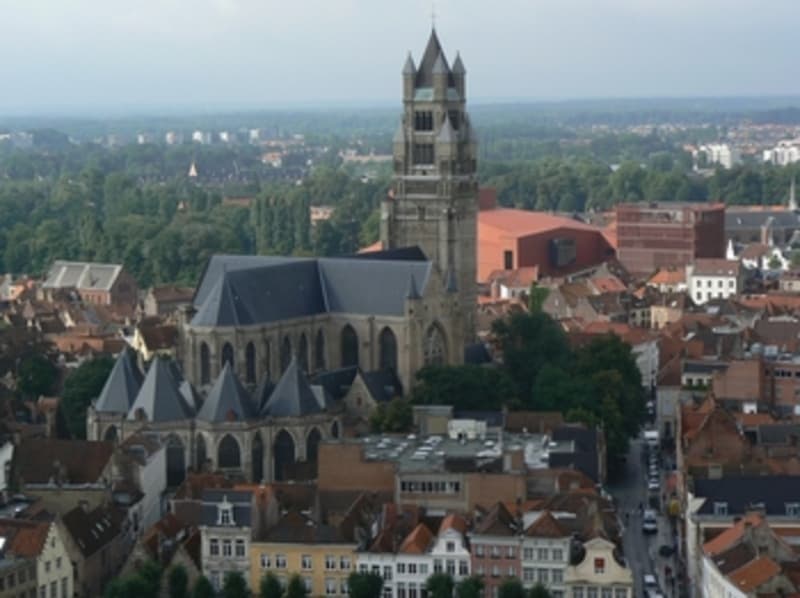
This fine 12th-century church only became a cathedral in 1834. The tower was accordingly raised, in a sensitive Romanesque style, to surpass the nearby Church of Our Lady.
The Holy Savior Cathedral (Sint-Salvatorskathedraal) was not originally built to be a cathedral - it obtained that status only in the 19th century. When Sint-Salvator was founded in the 10th century, it was just a common parish church.
At that time, the Sint-Donatius Church, which is located at the very heart of Bruges opposite of the town hall, was the most important religious building of the city. At the end of the 18th century, the French inhabitants of Bruges threw out the bishop and destroyed the Sint-Donatius Church, his residence.
In 1834, shortly after Belgium's independence in 1830, a new bishop was installed in Bruges and the Sint-Salvator church obtained the status of cathedral. However, the building didn't really look like a cathedral. It was a lot smaller and less imposing than the nearby Onze-Lieve-Vrouwekerk and had to be adapted to its new role. For instance, a higher and more impressive tower was needed.
The oldest surviving part, dating from the end of the 12th century, formed the base of the mighty tower. In 1839 a fire destroyed the roof of the cathedral. William Chantrell, an English architect, famous for his neo-Gothic restorations of English churches, was asked to restore to Sint-Salvator its former glory. At the same time he was authorized to make a project for a higher tower, in order to make it taller than that of the Onze-Lieve-Vrouwekerk.
Instead of adding a Neo-Gothic tower extension, Chantrell chose a very personal Romanesque design. After completion there was a lot of criticism and the royal commission for monuments, without authorization by Chantrell, had placed a small peak on top of the tower because the original design was deemed too flat.
In 1834, shortly after Belgium's independence in 1830, a new bishop was installed in Bruges and the Sint-Salvator church obtained the status of cathedral .
In 1834, shortly after Belgium's independence in 1830, a new bishop was installed in Bruges and the Sint-Salvator church obtained the status of cathedral .
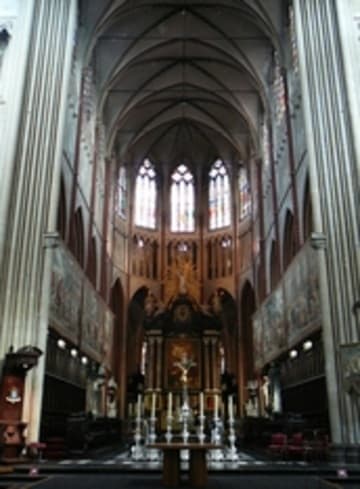
The Sint-Salvator Cathedral currently houses many works of art that were originally stored in its destroyed predecessor, the Sint-Donatius Cathedral. The wall-carpets that can be seen when entering the church were manufactured in Brussels by Jasper van der Borcht in 1731. These were commissioned by bishop Hendrik van Susteren for Sint-Donatius. In the choir the original 16th century podium can still be admired.
Highlights from Sacred Destinations
Highlights from Sacred Destinations
Advertisement
Advertisement
Advertisement
Where on earth