Highlights from Sacred Destinations
Explore the site
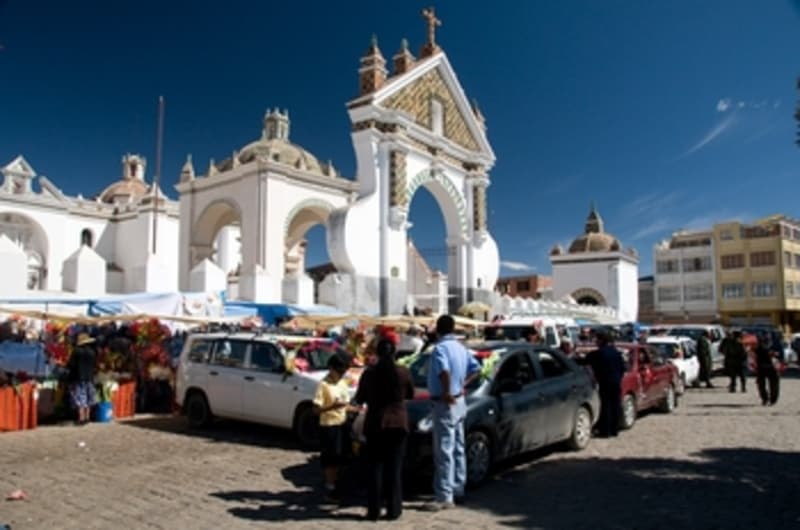
The Basilica de Virgen de la Candelaria dominates the town with its gleaming white exterior , Moorish-style domes and colorful azulejos (Portuguese-style blue ceramic tiles).
/ Bolivia / Virgen de la Candelaria
Virgin Mary (Candelaria) · 1576
This sparkling white basilica is home to a miraculous statue of the Virgin Mary made by an Inca craftsman in 1576. The patron saint of Bolivia, the Virgin of Copacabana receives many pilgrims and festivals in her honor.
The Virgen de la Candelaria in Copacabana is a statue of the Virgin Mary sculpted by an Inca craftsman in 1576. Believed to work miracles, the statue of the "Dark Virgin of the Lake" is the most important pilgrimage destination in Bolivia.
The Black Madonna was moved from its shrine to a chapel in 1583, which was enlarged by the Spanish in a Moorish style in 1619. The statue soon gained a reputation throughout Bolivia and Peru for working miracles. The present Basilica de la Virgen de Candelaria was completed in 1805.
The far more famous Copacabana, the beach in Rio de Janeiro, derives its name from this one: the Brazilian beach was named after the home of the Virgen de la Candelaria after she saved some Brazilian fisherman from another storm on Lake Titicaca.
The Black Madonna was moved from its shrine to a chapel in 1583, which was enlarged by the Spanish in a Moorish style in 1619.
The Black Madonna was moved from its shrine to a chapel in 1583, which was enlarged by the Spanish in a Moorish style in 1619.
The Basilica de Virgen de la Candelaria dominates the town with its gleaming white exterior, Moorish-style domes and colorful azulejos (Portuguese-style blue ceramic tiles). During festivals, the courtyard is filled with colorful flowers.
The venerated statue, Camarin de la Virgen de Candelaria, is made of dark wood and stands approximately four feet tall. The silver ship at the bottom of the altar represents the moon, while the gold statue above the Virgin's head symbolizes the power of the sun.
The Virgin stands in a mechanical niche high above the altar. On weekends, the priests rotate the statue so that she faces the main chapel; on weekdays, when there are fewer pilgrims here, they spin her around so that she looks over a smaller chapel on the other side.
The statue of the "Dark Virgin of the Lake" is never removed from the cathedral, for popular belief says this would cause a devastating storm and flood of Lake Titicaca. A finely-dressed replica is taken out on festival processions.
Believers have bestowed millions of dollars worth of gifts upon the Virgin. In 1879, the government of Bolivia sold some of her jewelry to finance the War of the Pacific against Chile. The cathedral also houses European and local religious art, much of which is in the Museo de la Catedral. The museum's collection includes hundreds of paper cranes donated by a Japanese woman in the hope of bearing an intelligent child.
Highlights from Sacred Destinations
Highlights from Sacred Destinations
Advertisement
Advertisement
Advertisement
Where on earth