Highlights from Sacred Destinations
Explore the site
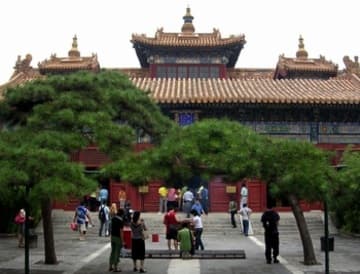
The Yonghe Gong is an attractive complex of progressively larger buildings topped with ornate yellow-tiled roofs.
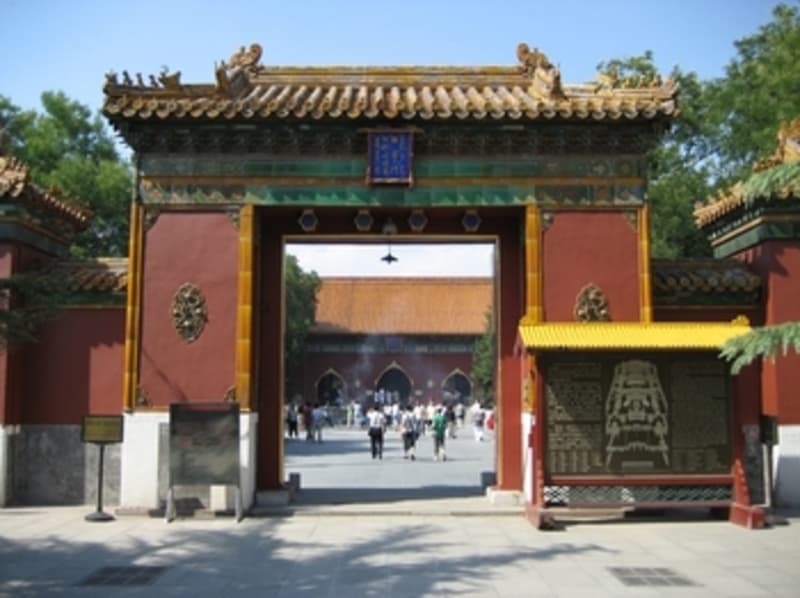
/ China / Lama Temple
Sacred site
This temple is fairly touristy but is still worth a visit for its colorful 17th-century architecture. It is an active Tibetan Buddhist center, but one that is officially sponsored by the Chinese government.
Yonghe Gong (Tibetan Lama Temple) in northern Beijing is fairly touristy, but it is the most interesting religious site in the city after the Temple of Heaven and well worth a visit. It has colorful, 17th-century architecture and is an active Tibetan Buddhist center, although one that is officially sponsored by the government.
Yong He Gong was built in 1694 as the residential palace of Prince Yin Zhen. In 1723, when the prince became the Emperor Yong Zheng and moved into the Forbidden City, the building was retiled in imperial yellow and converted to a temple (as was the usual custom).
It became a lamasery in 1744, housing Buddhist monks from Tibet and Inner Mongolia. The temple supervised the election of the Mongolian Living Buddha, who was chosen by lot from a gold urn.
After the Civil War in 1949, the temple was closed and declared a national monument. Remarkably, it escaped damage during the Cultural Revolution. It remained closed for 30 years, after which it was reopened mainly as a tourist attraction.
Yonghe Gong is an active Tibetan Buddhist centre, but it is government-sponsored and mainly used to demonstrate China respecting the religious freedom of minorities. It's unclear how genuine the Tibetan monks here are, but they are certainly state-approved. This is where, in 1995, the puppet Panchen Lama chosen by the Chinese government was officially sworn in. Just before that, the Dalai Lama's own choice for the position, the 6-year-old Gedhum Choekyi Nyima, disappeared.
Once something of a circus, Yong He Gong is slowly starting to feel like a place of worship, as there are now many Chinese devotees of Tibetan Buddhism.
Yong He Gong was built in 1694 as the residential palace of Prince Yin Zhen.
In 1723, when the prince became the Emperor Yong Zheng and moved into the Forbidden City, the building was retiled in imperial yellow and converted to a temple (as was the usual custom).
The Yonghe Gong is an attractive complex of progressively larger buildings topped with ornate yellow-tiled roofs. The Yonghe Gate dates from 1696 and has statues of celestial guardians. Inside are prayer halls, courtyards, and several rather beautiful incense burners, including a particularly ornate one in the second courtyard that dates back to 1746.
The Falun Dian (Hall of the Wheel of Law), second to last of the major buildings, contains a 6m (20-ft.) bronze statue and paintings of Tsongkapa (1357-1419), the founder of the Yellow Hat (Geluk) sect of Tibetan Buddhism, which is now the dominant school of Tibetan Buddhism. He's easily recognized by his pointed cap with long earflaps. The thrones next to the statue are for the Dalai Lamas when they used to come here to teach.
The last and grandest of the five central halls is the Wanfu Ge (Tower of Ten Thousand Happinesses), which houses the temple's prize possession - a huge Tibetan-style statue of Maitreya (the future Buddha), 18m (60 ft.) tall. A gift for Emperor Qianlong from the seventh Dalai Lama, it is carved from a single piece of Tibetan white sandalwood and it took three years to ship it to Beijing.
Highlights from Sacred Destinations
Highlights from Sacred Destinations
Advertisement
Advertisement
Advertisement
Where on earth