Highlights from Sacred Destinations
Explore the site
Most of the ruins date from the Roman Empire, including a well-preserved theater, an amphitheater, villas, and superb mosaic floors.
/ Cyprus / Salamis
Sacred site
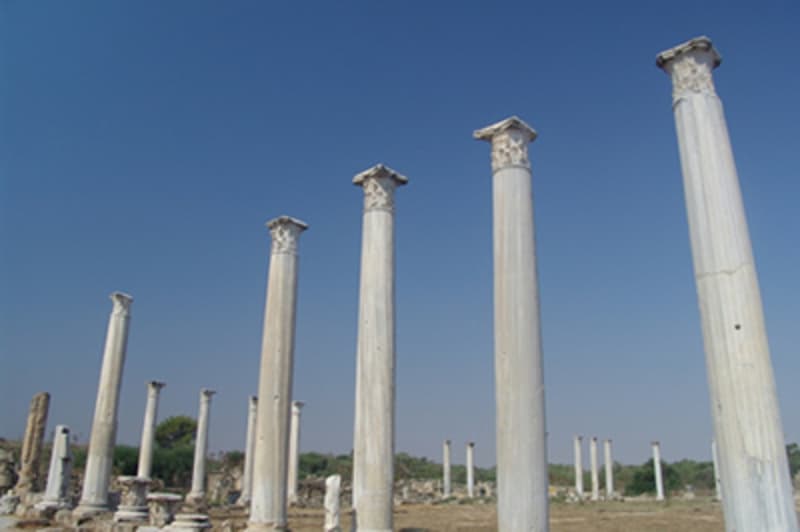
The ruins of the ancient Roman city of Salamis constitute one of the most impressive archaeological sites on Cyprus. St. Paul and St. Barnabas established a church nearby.
The ruins of the ancient Roman city of Salamis constitute one of the most impressive archaeological sites on Cyprus.
St. Barnabas and St. Paul arrived in Salamis and established a church near here.
After surviving earthquakes and pirate raids, the city was abandoned in the 7th century AD when the population moved to what is now Gazimagusa.
Most of the ruins date from the Roman Empire, including a well-preserved theater, an amphitheater, villas, and superb mosaic floors. Much of the ancient city is overgrown with a tangle of bushes and dune grass, which only serve to enhance the site's serene, poignant beauty.
There are very extensive ruins. The theatre, and the gymnasium have been extensively restored. Numerous statues are displayed in the central court of the gymnasium most of which are headless, destroyed by Christians. While a statue of Augustus originally belonged here, some columns and statues originally adorned the theatre and were only brought here after an earthquake in the 4th century.
The theatre is of Augustean date. It could house up to 15.000 spectators. It was destroyed in the 4th century. There are baths, public latrines (for 44 users), various little bits of mosaic, a harbour wall, a Hellenistic and Roman agora and a temple of Zeus that had the right to grant asylum.
Byzantine remains include the basilica of Bishop Epiphanos (AD 367–403). It served as the metropolitan church of Salamis. St. Epiphanios is buried at the southern apse. The church contains a baptistry heated by hypocausts. The church was destroyed in the 7th century and replaced by a smaller building to the south.
Highlights from Sacred Destinations
Highlights from Sacred Destinations
Advertisement
Advertisement
Advertisement
Where on earth