Highlights from Sacred Destinations
Explore the site
Four enormous bell-shaped mounds of bones occupy the corners of the chapel.
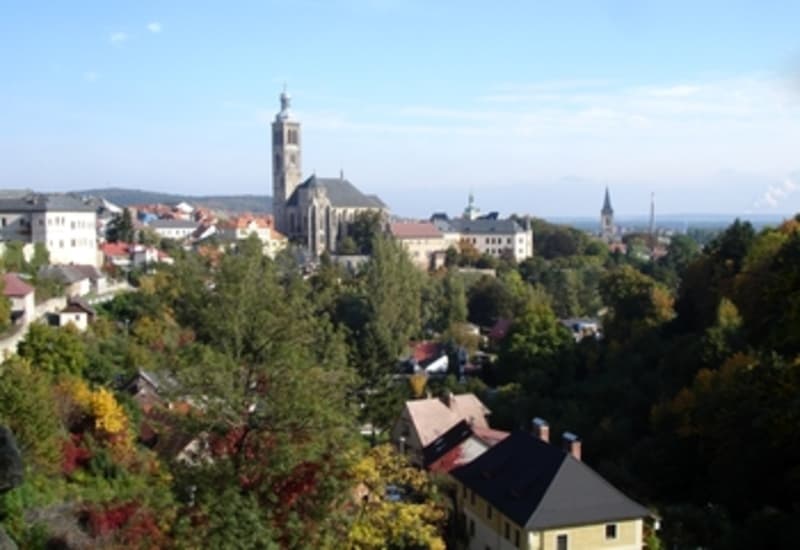
/ Czech Republic / Sedlec Ossuary
All Saints · 1400; bone decoration 1870
The pretty little Gothic chapel of the Holy Trinity in Sedlec, a suburb of Kutna Hora, is built over an ossuary that is decorated with more than 40,000 artfully arranged human skeletons.
The Sedlec Ossuary (kostnice Sedlec) a small Christian chapel, is located beneath the Church of All Saints (Hřbitovní kostel Všech Svatých) in Sedlec, a suburb of Kutná Hora in the Czech Republic.
The ossuary of the "Bone Church," as it is popularly known, contains approximately 40,000 human skeletons which have been artistically arranged to form decorations and furnishings for the chapel.
Henry, the abbot of the Cistercian monastery in Sedlec, was sent to the Holy Land by King Otakar II of Bohemia in 1278. When he returned, he brought with him a small amount of earth from Golgotha, where Christ was crucified, and sprinkled it over the abbey cemetery.
The presence of earth from the Holy Land in Sedlec soon spread and the cemetery became a highly desirable burial site for the faithful throughout Central Europe. During the Black Death in the mid 14th century and after the Hussite Wars in the early 15th century, thousands of people were buried there and the cemetery had to be greatly enlarged.
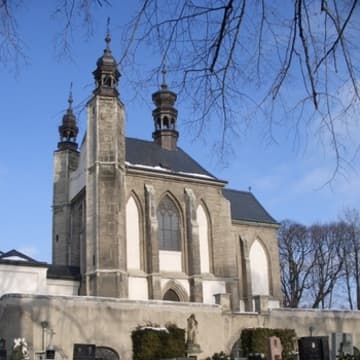
Around 1400 a Gothic church, the Church of All Saints, was built in the center of the cemetery. It had a vaulted upper level and a lower chapel to be used as an ossuary for the mass graves unearthed during construction.
After 1511 the task of exhuming skeletons and stacking their bones in the chapel was, according to legend, given to a half-blind monk of the order.
Between 1703 and 1710 a new entrance was constructed to support the front wall, which was leaning outward, and the upper chapel was rebuilt. This work, in the Czech Baroque style, was designed by Jan Santini Aichel.
In 1870, František Rint, a woodcarver, was employed by the Schwarzenberg family to put the boneheaps into order. The results of his efforts speak for themselves.
Henry, the abbot of the Cistercian monastery in Sedlec, was sent to the Holy Land by King Otakar II of Bohemia in 1278 .
Around 1400 a Gothic church, the Church of All Saints , was built in the center of the cemetery.
Four enormous bell-shaped mounds of bones occupy the corners of the chapel. An enormous chandelier of bones hangs from the center of the nave with garlands of skulls draping the vaults.
Other works include piers and monstrances flanking the altar, a large Schwarzenberg coat-of-arms (including a bird skeleton pecking at the eye socket of a human skull), and the signature of Master Rint, also executed in bone, on the wall near the entrance.
Similar ossuary chapels elsewhere include the Catacombe dei Cappuccini in Parlermo, Sicily, and the Capella dos Ossos ("Bone Chapel") in Evora, Portugal. For other macabre sacred sites, see our Dead on Display category.
Highlights from Sacred Destinations
Highlights from Sacred Destinations
Advertisement
Advertisement
Advertisement
Where on earth