Highlights from Sacred Destinations
Explore the site
Paul's name is located where he was buried, in a valley south of the St.
/ Egypt / St. Paul's Monastery
St. Paul of Thebes · 5th C
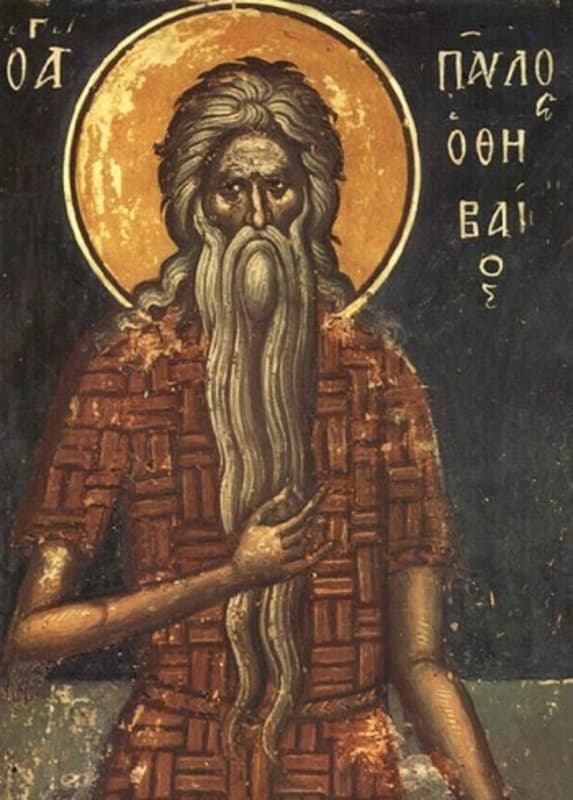
This ancient monastery marks the burial place of St. Paul of Thebes, a hermit who moved to the desert around 250 AD. The monastery has three churches and many important manuscripts.
St. Paul's Monastery (Deir Mar Boulos) in the Eastern Desert of Egypt is an ancient monastery dedicated to the hermit St. Paul of Thebes, who moved to this spot in the wilderness around 250 AD. Originally built in the 5th century, the monastery now has three churches and contains many important manuscripts.
The life of St. Paul of Thebes was recorded early, but has always been intertwined with fabulous legends. Born into a wealthy family, Paul abandoned civilization and fled the Decian persecution around 250 AD, when he was only 16 years old, to become a hermit in the Eastern Desert.
Living a life of extreme austerity from until his death at the ripe old age of 113, the hermit is said to have been fed a half-loaf of bread each day by a raven.
In the most famous episode of his life, Paul was visited by the desert monk St. Anthony around 345 AD. Nearing the end of his own life of austerity, Anthony had become tempted by vanity in thinking he was the first of the Desert Fathers. So God led him to meet one who had preceded him.
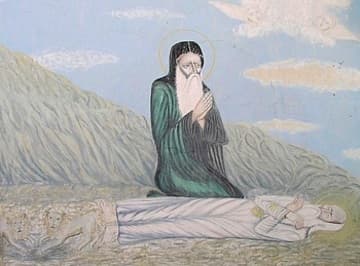
Paul died during Anthony's visit. According to one version of the legend, Anthony requested two lions to dig a grave. Another version says that, before his death, Paul requested the robe of Pope Athanasius be brought to him for burial, then died while Anthony was away on the errand. Either way, two lions dug the grave and St. Anthony buried the hermit there, designating him a saint.
St. Paul's Monastery was built around the hermit's cave by the 5th century. It suffered from Bedouin raids throughout its history, the worst being in 1484, when all the monks were murdered, the monastery was plundered, and the Bedouins occupied it for 80 years.
Deir Mar Boulos was rebuilt under the patronage of Pope Gabriel VII of Alexandria (1526-69), then attacked and destroyed again towards the end of the century. The monastery was deserted for 119 years, then extensively reconstructed and repopulated by monks from St. Anthony's Monastery under the patronage of Pope John XVI of Alexandria (1676-1718).
Living a life of extreme austerity from until his death at the ripe old age of 113, the hermit is said to have been fed a half-loaf of bread each day by a raven.
The monastery was deserted for 119 years, then extensively reconstructed and repopulated by monks from St.
The monastery that bears St. Paul's name is located where he was buried, in a valley south of the St. Anthony monastery. It has been little changed over the years, preserving its remarkably ancient heritage.
The monastery has four churches, the most important of which is the underground Church of St. Paul that contains the hermit's cave and burial place. Its walls are painted with well-preserved frescoes and the ceiling is hung with ostrich eggs, symbols of the resurrection. The larger Church of St. Michael has a gilded icon of John the Baptist's severed head.
St. Paul's possesses many illustrated manuscripts, including the Coptic version of the Divine Liturgy and the Commentary on the Epistle of Saint Paul to Titus by John Chrysostom.
It is possible to hike from St. Paul's to St. Anthony's Monastery along a trail across the plateau, but this is a demanding trek and should be done with a guide.
Highlights from Sacred Destinations
Highlights from Sacred Destinations
Advertisement
Advertisement
Advertisement
Where on earth