Highlights from Sacred Destinations
Explore the site
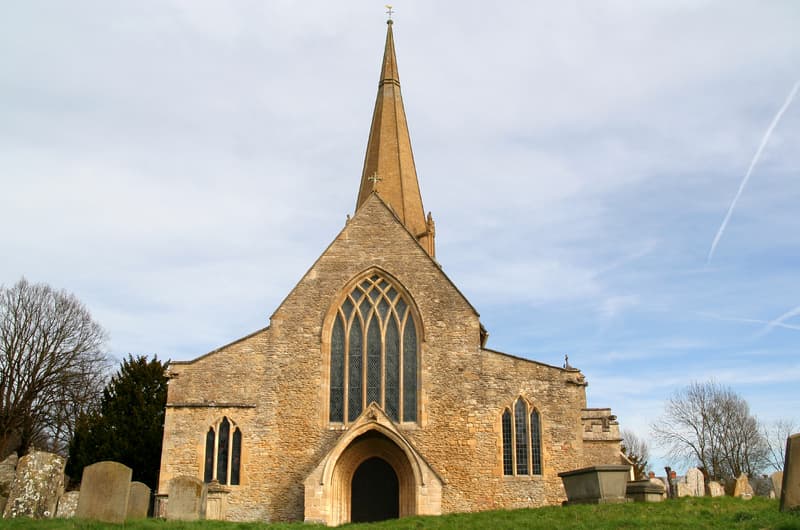
The exterior of Bampton's church is very attractive, with a large and elegant spire supported by minature saint-topped flying buttresses, a large west window, and multiple porches.
/ England / Church of St Mary
Virgin Mary; previously John the Baptist (1292); Mary and John the Baptist (1317 · c. 1270-1350
Originally a Saxon minster, this large parish church dates primarily from the 12th century. It has an attractive 13th-century spire and interesting Romanesque decorations.
The Church of St. Mary the Virgin is the parish church of Bampton in Oxfordshire. Originally a Saxon minster, the present building dates primarily from the 12th century and is exceptionally large for a parish church. It has an attractive 13th-century spire and a carved Gothic reredos.
Bampton's parish church existed even before the Norman conquest, when most of England's parish churches were built. Originally an Anglo-Saxon minster church, in 1069 the church was given by King William I to the new Exeter Cathedral (home of the king's personal bishop). The original Saxon building was almost entirely rebuilt in the Norman style in the latter half of the 12th century.
Throughout the later Middle Ages, Bampton was the mother church of a large parish and received frequent expansions and redecorations. The tower was raised and the spire was added in the mid-13th century. At the end of the 13th century, a new arcade in the nave, the windows in the aisle wall, and the chapel on the south aisle were added. The early 14th century saw the addition of the west porch and the windows in the chapel off the north transept.
The south porch was built in the late 15th century, along with the clerestory. The Horde Chapel east of the south transept is possibly a 17th-century reconstruction of an existing chapel. In 1870, the clerestory of the nave and chancel were removed and replaced with the present roof.
Originally an Anglo-Saxon minster church, in 1069 the church was given by King William I to the new Exeter Cathedral (home of the king's personal bishop).
In 1870, the clerestory of the nave and chancel were removed and replaced with the present roof.
The exterior of Bampton's church is very attractive, with a large and elegant spire supported by minature saint-topped flying buttresses, a large west window, and multiple porches. Bits of the original Saxon masonry can still be seen in the lower part of the tower and the northwest turret.
The interior is not terribly exciting, but has some interesting elements. Some herringbone-work from the Saxon church can be seen in the nave. The font in the back of the nave is finely carved with flower and ball-flower decorations. A variety of symbols are carved into the ends of the choir stalls. On display in the nave is an almost unrecognizable statue of John the Baptist, who fell from the exterior in 1990.
A side chapel in the east end contains a badly worn effigy of a knight. He is thought to be Sir Gilbert Talbot (b. 1390), who served in the Hundred Years War and lived at Bampton Castle.
Behind the altar in the chancel is the highlight of St. Mary's Bampton: a miniature c.1400 carved reredos depicting Christ and the Twelve Apostles. Some traces of color can still be seen.
Highlights from Sacred Destinations
Highlights from Sacred Destinations
Advertisement
Advertisement
Advertisement
Where on earth