Highlights from Sacred Destinations
Explore the site
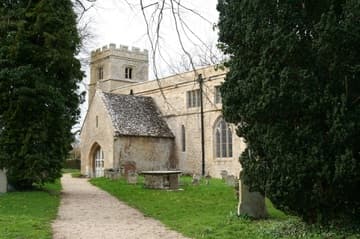
Black Bourton's church is small but attractive from the outside and cozy and charming on the inside.
/ England / Church of St Mary
Virgin Mary · 12th-13th C
This charming old church is well worth a visit for its Norman architecture and faded 13th-century murals of biblical scenes and saints.
St. Mary's Church is the parish church of Black Bourton, a village in Oxfordshire with less than 300 people. This charming old church is well worth a visit for its Norman architecture and picturesquely faded 13th-century murals.
Black Bourton's parish church was built in a Transitional style at the end of the 12th century, with wall paintings and some minor remodeling done the late 13th century.
The murals were whitewashed after the Reformation and remained hidden until a Victorian vicar, Canon James Lupton, uncovered and preserved them in 1866. But while he was away in London, his curate and a churchwarden covered them with whitewash again.
The vicar was furious, but the paintings remained covered until E.W. Tristram uncovered them again in 1932. Their long existence beneath whitewash accounts for their preservation, although they are still quite faded and patchy in some areas.
The murals were whitewashed after the Reformation and remained hidden until a Victorian vicar, Canon James Lupton, uncovered and preserved them in 1866.
Tristram uncovered them again in 1932.
Black Bourton's church is small but attractive from the outside and cozy and charming on the inside. The squat tower is placed on the west end.
Entrance is through the south porch, but don't miss the small priest's door to the east, which has Saxon carvings. (Sadly, I realized this too late myself so there aren't any close photos of it in the gallery.)
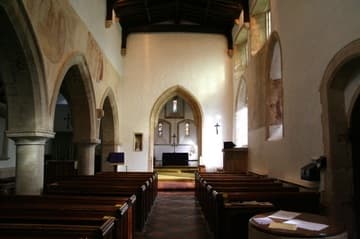
Inside, the slender nave has just one side aisle (on the left/north) which gives the interior a pleasing lack of symmetry. A very simple round Norman font, dating from the late 12th century, stands near the entrance. A carved stone pulpit, also Norman, is at the front of the nave on the south wall.
But the indisputable highlight of Black Bourton's interior is the faded 13th-century murals that adorn the arcade between the nave and north aisle as well as most of the south wall.
On the north arcade, the main murals from left to right are as follows:
On the south wall of the nave, a large mural extends between the two main windows. It depicts the Adoration of the Magi, with King Herod pointing them in the right direction on the right and the Virgin and Child receiving them on the left.
In the left window niche is a mural of the Martyrdom of Thomas Becket and in the right window niche is the Angel Gabriel appearing to St. Joseph.
In the back corner of the south wall is a badly damaged mural of an unknown (to me) scene, with a bishop high above on the left and the Hand of God reaching down from the top center.
A shallow chapel extends off of the north aisle and consists almost entirely of a large monument to Eleanor Hungerford (d. 1592), a member of the prominent Hungerford family who lived in the manor house in Black Bourton (now gone). On the wall nearby is a finely carved memorial to Anthony Hungerford (d. 1703).
The chancel, reached through a Norman archway, is whitewashed and simple and has no murals. The east wall is pierced with three slender windows depicting Mary, John the Baptist, and Christ. There are some fine carved corbels on both walls. The chancel has been carpeted in yellow, which certainly would not have been my choice but actually looks nice with the white walls.
Stretching behind the church is an extensive churchyard, with many gleaming new gravestones to go with the old stone tombs. In a prominent position in the front of the church is a small military cemetery that is the resting place of members of the Royal Air Force, many of whom died in their 20s in World War II. A major RAF base is just a few miles from Black Bourton in Brize Norton.
Highlights from Sacred Destinations
Highlights from Sacred Destinations
Advertisement
Advertisement
Advertisement
Where on earth