Highlights from Sacred Destinations
Explore the site
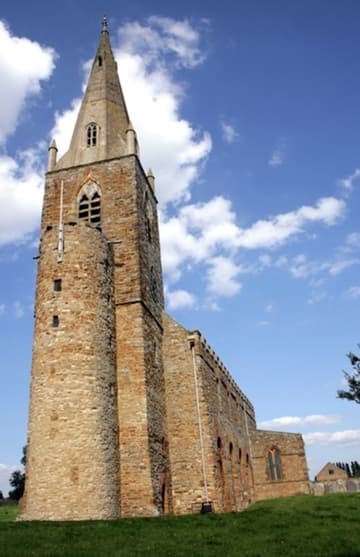
Exterior Brixworth Church is made of ironstone and has a striking appearance, due to its high, narrow nave and round stair turret on the west tower.
/ England / Brixworth Church
All Saints · 7th C
All Saints Church, Brixworth is a Saxon church dating from the 7th century. It is the largest in England still standing from this period and has a number of interesting features.
Brixworth Church (All Saints) in Northamptonshire is an Anglo-Saxon parish church dating from the 7th century. It is the largest in England still standing from this period and has a number of interesting features.
The Church of All Saints was built sometime before 675 AD as part of a monastery. It was badly damaged by the Danes in 876 and converted to a parish church in the 10th century. At that time, the west narthex was replaced with the present tower and stair turret.
The church was significantly enlarged in the 13th century, including the addition of a south aisle, porch and chancel. All these were removed as part of a major restoration in 1865, but the 13th-century south chapel was left in place.
The Church of All Saints was built sometime before 675 AD as part of a monastery.
It was badly damaged by the Danes in 876 and converted to a parish church in the 10th century.
Brixworth Church is made of ironstone and has a striking appearance, due to its high, narrow nave and round stair turret on the west tower. Most of the present church dates from the Anglo-Saxon period; the nave from the 7th century and the tower from the 10th century. The chapel extending from the south wall is 13th-century Gothic and the south portal dates from the 12th century.
The left jamb of the portal contains an ancient sculpture of an eagle, known as the Brixworth Eagle. Pevsner says this is the Eagle of St. John, dating from the 9th century; others think it could be a mason's mark or a reused symbol of a Roman legion.
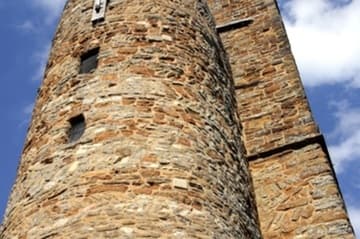
The original entrance to the church was on the west end. The lower stage of the west tower dates from the 7th century; the upper stage mostly from the 14th century. The distinctive round stair turret (10th century) has plain rectangular windows and a flat roof.
At the east end is a polygonal apse that was rebuilt in c.1865 over the 7th-century foundations, which can be seen at the base. On either side of the apse are arched openings that connected the nave with an underground "ring crypt." This subterranean ambulatory is now an open trench in the ground around the apse. It presumably wrapped around a crypt that contained relics, but this has not been discovered. The single-light windows above the apse are from the 7th century as well.
Inside, the round arches on the side walls (7th century) are made of reused Roman tiles from a local villa. The arches are now filled in, but originally gave access to side aisles. The large rectangular pillars are plain and made of rubble. The arch over the apse in the chancel also has Roman tiles.
At the west end of the nave is an arched portal to the tower (7th century) and a triple-arched opening above (10th century). The Lady Chapel on the south side of the nave contains a 13th-century monument of a knight, with crossed legs believed to designate a Crusader.
Next to the pulpit is an intriguing reliquary, dating perhaps from c.1300. It was found inside a stone box in the wall of the Lady Chapel during restoration work in 1821. The carved wooden box bears the partially obscured inscription "15-- T.B." This almost certainly refers to Thomas Bassenden, the last chantry priest of Brixworth, who hid the relics away from Protestant desecration during the Reformation of the 1500s.
Inside the reliquary is a single bone that was wrapped in a cloth. The relic may belong to St. Boniface, since early records of Brixworth Church make several references to guilds of St Boniface and festivities around St. Boniface Day. Boniface (d.754) was born in Devon and later became Bishop of Mainz and a martyr.
Highlights from Sacred Destinations
Highlights from Sacred Destinations
Advertisement
Advertisement
Advertisement
Where on earth