Highlights from Sacred Destinations
Explore the site
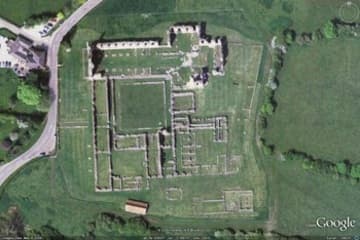
Today the Byland Abbey site is dominated by the remains of the great abbey church.
/ England / Byland Abbey
Sacred site
Byland Abbey is one of the three great Cistercian monasteries of North Yorkshire, with Fountains and Rievaulx. Although the community had a rocky start, its abbey church was once the largest in England.
Byland Abbey was founded by a group of Savigniac monks after several unsuccessful foundation attempts since their departure from Furness Abbey in 1134. The Foundation History of Byland vividly describes the monks embarking on the journey with only their clothes, a few books and a cart driven by eight oxen.
In 1143, the Furness monks settled just over a mile from Rievaulx Abbey, but the location proved to be problematic. The newcomers apparently followed a different timetable than the monks at Rievaulx, and the latter complained about the newcomers' bells interfering with their own and causing confusion.
Rather than change their daily timetable, the Furness wanderers moved on again in 1147. They relocated to Stocking, in Kilburn, leaving their former lands to the monks of Rievaulx, who happily diverted the river and doubled the size of their precinct in preparation for their next building campaign.
It was an eventful year for the small band of monks: also in 1147, Byland Abbey was brought within the Cistercian family along with the entire Savignac order. The now-Cistercian monks settled in at Stocking, where they built a small stone church and some other buildings, but they didn't plan to stay. From the site at Stocking, they began to prepare a site three miles east, at Byland, for more permanent facilities.
Upholding the Cistercians’ reputation for effective transformation of the landscape, the Byland monks prepared the site for monastic occupation by draining the marshland, clearing the wooded areas and defining boundaries. Construction began around 1155. The abbey church was not completely finished until the 1190s, but in October 1177, the monks finally had a permanent home at Byland.
Although it never achieved the celebrity or wealth of its neighbour Rievaulx, Byland Abbey did boast the largest church in England and one of the most impressive Cistercian churches in Europe. Its able abbot, Roger, who had overseen the community during all the moves and construction, successfully attracted the patronage of wealthy landowners, and the community also did well for itself in the export of wool. By the late 12th century Byland, Fountains and Rievaulx were described as "the three shining lights of the North."
On November 30, 1538, Abbot John Alanbridge (1525-1538), Prior Robert Barker and the 24 remaining monks of Byland gathered in their chapter house for the final time and surrendered their abbey, with all its property, to the Crown. The site was granted to Sir William Pickering in 1539. Destruction of the abbey began immediately and continued until the 18th century.
Byland Abbey was founded by a group of Savigniac monks after several unsuccessful foundation attempts since their departure from Furness Abbey in 1134.
In 1143, the Furness monks settled just over a mile from Rievaulx Abbey , but the location proved to be problematic.
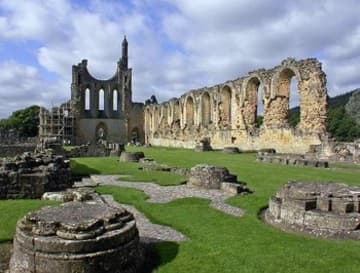
Today the Byland Abbey site is dominated by the remains of the great abbey church. This was an impressive building built as large as a cathedral in the Early Gothic style. Both Romanesque and Gothic arches can be seen among the ruins, illustrating the major period of transition in medieval architecture in the 12th century. The huge rose window in the west front, now partially broken, may have been a model for the rose at York Minster.
Remains of mosaic tiles in the south transept offer a glimpse of how magnificent the church was in the Middle Ages. Other remarkable remains at Byland include the extensive cloister, with the remains of the Collation porch, and stone seats for the lay brothers. Excavations at Byland have unearthed the only stone lectern base in England. Byland’s altar is now at Ampleforth Abbey.
Highlights from Sacred Destinations
Highlights from Sacred Destinations
Advertisement
Advertisement
Advertisement
Where on earth