Highlights from Sacred Destinations
Explore the site
The church has a central nave, a chancel raised on shallow steps, two side aisles on the north and south, and a west tower with three bells (two 15th-century, the third from 1827).
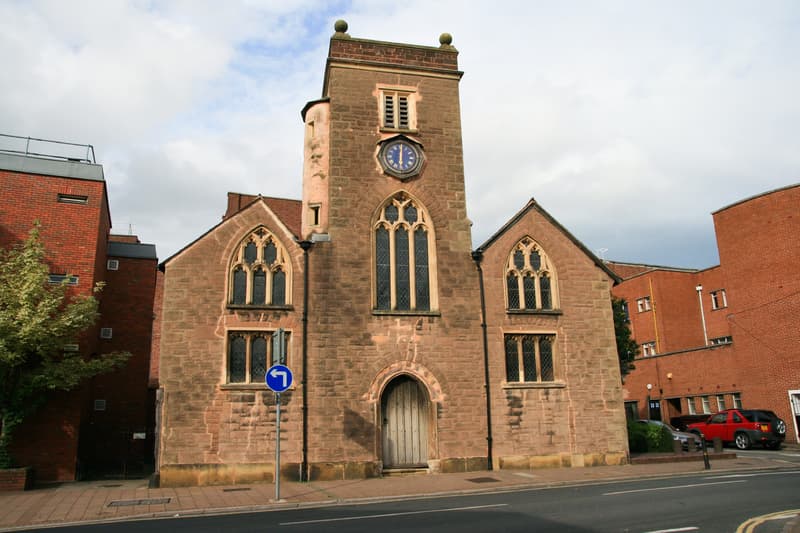
/ England / St. Mary Arches
Virgin Mary · 12th-13th C
St. Mary Arches is a parish church in Exeter, notable for the Norman arches for which it is named.
St. Mary Arches is a mostly-Norman parish church in Exeter, notable for the Norman arches for which it is named.
St. Mary Arches dates from the Norman era and retains many of its Norman features, but has been much renovated and altered over the centuries. From the 14th to 16th centuries, it was the church of many merchants and mayors of Exeter, some of whom have monuments in the church.
John Wesley was once offered the chance to preach in the church, but the invitation was canceled amid worries his Methodist doctrine "might lead people into enthusiasm or despair."
St. Mary Arches Church survived the bombing of Exeter on May 4, 1942, but suffered severe damage the following day when a smoldering incendiary bomb erupted. The 15th-century wagon roof was badly damaged and much of the furnishings lost.
The church was restored in 1950 by S. Dykes-Bower. The roof was rebuilt as a barrel vault, using timbers from a US landing craft that took part in the D-day landings and had been beached on the Exe estuary. The outside was not so well restored; imitation stone was used to make repairs.
Today, St Mary Arches is the home to the colors of Devon's Home Guard and those who died defending Devon during the air-raids.
Mary Arches Church survived the bombing of Exeter on May 4, 1942 , but suffered severe damage the following day when a smoldering incendiary bomb erupted.
The church was restored in 1950 by S.
The church has a central nave, a chancel raised on shallow steps, two side aisles on the north and south, and a west tower with three bells (two 15th-century, the third from 1827).
St. Mary Arches is the only Devon parish church to retain two full Norman arcades, the "arches" from which it takes its name. The nave is flanked on each side by an arcade of four bays supported on plain circular Late Norman columns with square, scalloped capitals.
Behind the altar is a 17th century reredos, erected in 1696, and the altar and rails are of about the same date. The interior contains many fine monuments, most of the mayors of Exeter. The tomb of Thos. Walker, who died in 1628, has kneeling effigies of himself and wife.
On display in the Royal Albert Memorial Museum in Exeter is an important medieval vestment from St. Mary Arches. Dating from c.1500, it is one of very few such items to survive the Reformation in England. It consists of strips of silk, linen and canva, embroidered with silver-gilt threads in green, yellow, red, blue and black. The narrow bands are richly ornamented, featuring a crucifix and a series of saints under canopies.
The strips originally formed part of a cope, the semi-circular cloak worn by a priest at Mass. Such vestments were condemned at the Reformation, but the thrifty parishioners of St Mary Arches removed the offending figures, cut the cope into strips and re-assembled the pieces as a pall.
Highlights from Sacred Destinations
Highlights from Sacred Destinations
Advertisement
Advertisement
Advertisement
Where on earth