Highlights from Sacred Destinations
Explore the site
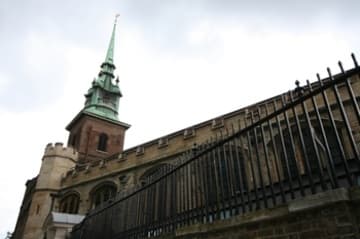
Many portions of the old church survived the war and have been sympathetically restored.
/ England / All Hallows by Tower
All Souls · 11th-15th C
Founded in 675 as part of an abbey, this church was built over a Roman building. Its proximity to the Tower of London gave it many royal and historic associations over the centuries.
All Hallows by the Tower is an ancient Anglican church located in the City of London, just uphill from the famous Tower of London.
All Hallows was first established in 675 by the now-defunct Saxon Barking Abbey and was for many years named after the abbey, as "All Hallows Barking." The church was built on the site of a former Roman building, traces of which have been discovered in the crypt.
The church was expanded and rebuilt several times between the 11th century and 15th century. All Hallows' proximity to the Tower meant that it acquired royal connections, with Edward IV making it a royal chantry and the beheaded victims of Tower executions being sent for temporary burial at All Hallows.
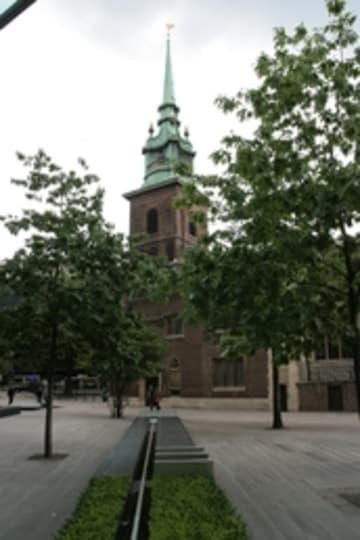
The church was badly damaged by a nearby explosion in 1649, which demolished its west tower, and only narrowly survived the Great Fire of London in 1666. It owed its survival to Admiral William Penn, father of William Penn of Pennsylvania fame, who saved it by having the surrounding buildings demolished to create firebreaks.
In 1926 a Roman pavement and many artifacts were discovered many feet below the church. Restored in the late 19th century, All Hallows was gutted by the Blitz in World War II and required extensive reconstruction, only being rededicated in 1957.
All Hallows by the Tower has connections with several famous persons, including:
All Hallows was first established in 675 by the now-defunct Saxon Barking Abbey and was for many years named after the abbey, as "All Hallows Barking.
The church was badly damaged by a nearby explosion in 1649, which demolished its west tower, and only narrowly survived the Great Fire of London in 1666.
Many portions of the old church survived the war and have been sympathetically restored. Overall, the interior looks like an upside-down boat; this reflects its longstanding nautical connections. Its outer walls are 15th century, with a 7th century Saxon doorway surviving from the original church. Many brasses remain in the interior and the church houses a brass rubbing center open to visitors.
Other notable features include three outstanding wooden statues of saints dating from the 15th and 16th centuries (the one of St James Compostella dates from 1484) and an exquisite font cover believed to have been carved in 1682 by Grinling Gibbons, which is regarded by many as one of the finest pieces of carving in London.
In the northeast corner is the altar tomb of Alderman John Croke (1477), which was destroyed by the air-raid of 1940 but completely restored from over 150 fragments.
Downstairs is the Undercroft Museum, with a treasury of communion plates, and a crypt. The latter contains an altar believed to have been carried on the Second Crusade by King Richard II.
Highlights from Sacred Destinations
Highlights from Sacred Destinations
Advertisement
Advertisement
Advertisement
Where on earth