Highlights from Sacred Destinations
Explore the site
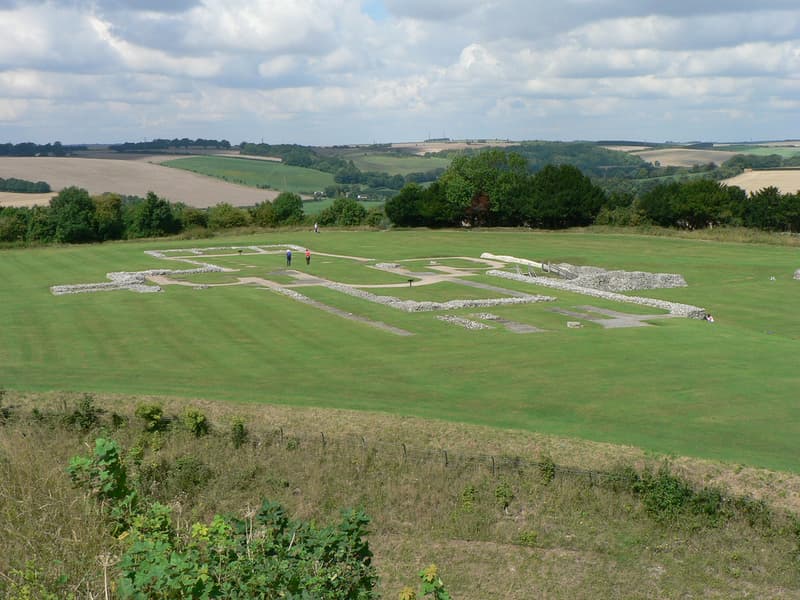
A large flat-topped mound, banks and ditches are the dominant features of Old Sarum today.
/ England / Old Sarum
Sacred site
This round plateau just outside the city was settled by Neolithic peoples, Romans, and Saxons before it hosted a Norman castle and cathedral from 1075 to 1219.
Old Sarum is an ancient hilltop site two miles from the city center of Salisbury. For more than 4,000 years it served as a fortress and religious site, from a Neolithic henge and fort to a Norman castle and cathedral. The site was abandoned in 1219 when the bishops moved to "New Sarum," or Salisbury.
Old Sarum was occupied since about 3,000 BC by a Neolithic community who built communal burial places, stock enclosures and large ritual enclosures known as henges (the same sort of structure, on a less monumental scale, as nearby Stonehenge and Avebury Henge).
From about 500 BC, during the Iron Age, the hilltop site was given further protection with double ditches and used as an administrative center and fort. It was later settled by the Romans (from c.60 AD), who called it Sorviodunum. They probably built a shrine to a local god on the hilltop. The site was at a major intersection of Roman roads: those from Winchester to Exeter; from Silchester; and from the Severn via the Mendip hills.
After the Romans left Britain, the Saxons took over Old Sarum. Arriving in 552 BC, they called the site Searobyrg. It became the center of a great royal estate and was eventually refortified by the Saxon kings to provide protection to local farmers and townsfolk.
In 1069, William the Conquerer and the Normans inherited the site from the Saxon kings. As Old Sarum was well-fortified and near a major crossroads, it was an ideal site for a royal castle. Construction on a wooden castle began immediately, and by 1070 William the Conquerer moved in. Old Sarum was the seat of Norman county government.
In 1075, a church council voted to move the bishopric of Sherborne to Old Sarum. A new cathedral was built in the outer bailey of the king's castle on Old Sarum between 1075 and 1092. Five days after the cathedral's consecration, it was badly damaged in a storm.
The extreme weather on the hilltop would prove to be a constant irritation to the Old Sarum bishops, who eventually petitioned the pope to allow them to move to Salisbury. The pope granted his permission and they made the move in 1219. With the bishops gone, the stone from the abandoned cathedral was used for Salisbury's gateways and the population declined. Henry VIII demolished the castle in 1519. By the 19th century, Old Sarum was deserted.
Arriving in 552 BC, they called the site Searobyrg .
From about 500 BC, during the Iron Age , the hilltop site was given further protection with double ditches and used as an administrative center and fort.
A large flat-topped mound, banks and ditches are the dominant features of Old Sarum today. On top are the foundation outlines of the Norman palace, castle and cathedral.
Highlights from Sacred Destinations
Highlights from Sacred Destinations
Advertisement
Advertisement
Advertisement
Where on earth