Highlights from Sacred Destinations
Explore the site
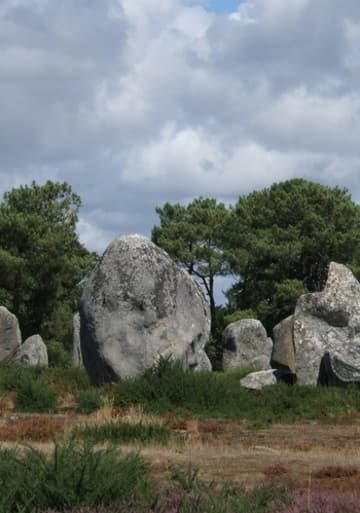
The Carnac Stones consist of both single standing stones ( menhirs ) and multistone clusters ( dolmens ).
/ France / Carnac Stones
Sacred site · 4500-2000 BCE
Located in a village in Brittany, northwestern France, the Carnac Stones are a huge system of more than 3,000 prehistoric standing stones erected between 4500 and 2000 BC.
Carnac is a small village of about 5,000 people in the region of Brittany, northwestern France. It is home to the Carnac Stones, a system of more than 3,000 prehistoric standing stones.
The Carnac Stones were hewn from local rock and erected by the pre-Celtic people of Brittany.
The megaliths were erected during the Neolithicperiod which lasted from 4500 BC until 2000 BC. The precise date of the stones is difficult to ascertain as little dateable material has been found beneath them.
About 3300 BC is the date most commonly estimated for the site's main phase of activity, but some megaliths may date to as early as 4500 BC.
One interpretation of the site is that successive generations visited the site to erect stones in honor of their ancestors.
The Carnac Stones consist of both single standing stones (menhirs) and multistone clusters (dolmens).
There are two main groups of stone alignments at Carnac, which are known as the Menec and Kermario alignments. Further smaller alignments are dotted around the area including the Kerlescan and the Petit Menec.
The Menec alignments are 12 converging rows of menhirs stretching more than a kilometre with the remains of a stone circle at either end. The largest stones, around 4m high, are at the wider, western end; they become smaller along the length of the alignment reaching around 0.6m high, at the extreme east they grow to in height.
A little further along to the east, this fanning layout is virtually repeated in what is called the Kermario alignment.
Highlights from Sacred Destinations
Highlights from Sacred Destinations

Advertisement
Advertisement
Advertisement
Where on earth