Highlights from Sacred Destinations
Explore the site
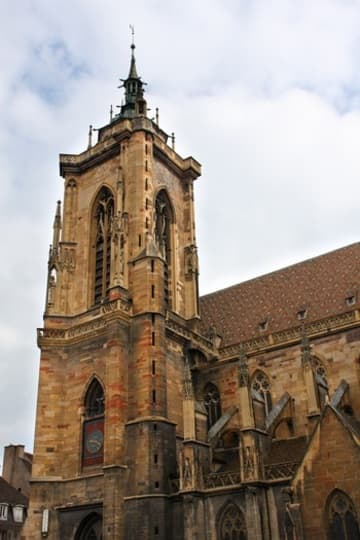
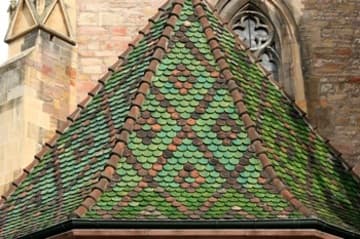
The church is built of red and golden stones in the shape of a Latin cross, with colorful tiled roofs giving it a local Alsatian flavor.
/ France / St-Martin
St. Martin · 1234-1365
The largest church in Colmar, St-Martin dates primarily from the 13th and 14th centuries and contains some notable Gothic art.
The Église Saint-Martin (St. Martin's Church) in Colmar, also known as Collégiale Saint-Martin (for its former status as a collegiate church) and Cathédrale Saint-Martin (for its large dimensions, though it has never been a cathedral), dates primarily from the 14th century and contains some notable Gothic artworks.
The first known building on this site was a Carolingian church built around 1000, which was followed by a Romanesque church. The present builidng is Gothic and was built between 1234 and 1365. The Renaissance crown over the bell tower was added in 1572.
The Église Saint-Martin suffered extensive damage during the French Revolution and was later restored. In 1982, archaeological excavations revealed the foundations of the Carolingian and Romanesque churches.
The first known building on this site was a Carolingian church built around 1000, which was followed by a Romanesque church.
The present builidng is Gothic and was built between 1234 and 1365.
The church is built of red and golden stones in the shape of a Latin cross, with colorful tiled roofs giving it a local Alsatian flavor. The tall, graceful choir at the east end is a contrast with the heavier west end, characterized by asymetrical towers and thick buttresses.
The exterior features several portals with intricately carved tympana. On the south transept is the Saint Nicholas Portal, with a double tympanum featuring the "Charity of St. Nicholas" below and a Last Judgment above.
There are a variety of interesting medieval sculptures on the exterior, including two examples of the Anti-Semitic Judensau: one in the shape of a gargoyle, the other appearing in the corner of a portal.
Inside, the most notable aspect of the nave is the set of the 13th-century stained glass windows, depicting biblical stories such as the Last Supper, Abraham and Isaac and the Ascension of Elijah.
The High Gothic choir dates from 1350-66. It includes an ambulatory, a rare feature in Alsatian churches, and radiating chapels containing medieval altars and statues.
The interior also features an impressive Baroque organ: its case dates from 1755 and the inner mechanism, originally by Johann Andreas Silbermann, were replaced in 1979.
Highlights from Sacred Destinations
Highlights from Sacred Destinations
Advertisement
Advertisement
Advertisement
Where on earth