Highlights from Sacred Destinations
Explore the site
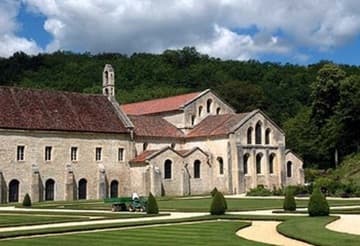
The lovely, warm-hued Abbey of Fontenay is well worth a visit.
/ France / Fontenay Abbey
Sacred site · 1139-47
Nestled in a wooded valley in Burgundy, the Abbey of Fontenay is a well-restored 12th-century Cistercian monastery founded by St. Bernard of Clairvaux.
Nestled in a wooded valley in Burgundy, the Abbaye de Fontenay is a well-restored 12th-century Cistercian monastery founded by St. Bernard of Clairvaux.
The Abbey of Fontenay was founded by St. Bernard of Clairvaux, founder of the Cistercian order, in 1118 on land he received from his uncle in a valley in Burgundy.
Cistercian monks moved into the abbey in 1130. In 1139, the Bishop of Norwich fled to Fontenay to escape persecution, and used his considerable wealth to help finance the building of the abbey church.
The abbey church at Fontenay was consecrated by Pope Eugene III in 1147. By 1200 the monastic complex was largely complete and large enough to serve 300 monks. In 1259, the devout King Louis exempted the Abbey of Fontenay from all taxes, and 10 years later the abbey became a French royal abbey.
In 1359, the Abbey of Fontenay was pillaged by the armies of King Edward III of England during the Hundred Years' War. It further suffered during the Wars of Religion. In 1745, the refectory was destroyed.
The year 1789 saw the beginning of the French Revolution; in 1790, the last eight monks left the abbey. The abbey was sold and turned into a paper millin 1791. The abbey suited the work of a paper mill perfectly, with its mill that could pound rags into pulp, its vaulted ceilings for airing during the fermentation process, and its large open floors for drying.
It seems a terrible fate for the elegant abbey to suffer, but actually its immediate industrial use saved it from a far worse fate. People of the post-Revolutionary had little interest in religious heritage and would have quickly dismantled it for building materials (as they did so many other abbeys) had it not been so useful intact.
For various reasons, the Fontenay paper company went under in 1903. In 1906, an art-loving banker from Lyon named Edouard Aynard bought the abbey with the intention of returning it to its medieval glory. As he put it, "I was caught by the irresistable attraction of the work of art to be revived and restored."
From 1906 to 1911, all the "parasite" structures related to the paper mill, such as workshops and chimneys, were torn down. Meanwhile, the abbey church was restored and excavated, revealing medieval tiles and tombs. Aynard's descendents continued to work on the abbey and it remains in the family today.
UNESCO declared the Abbey of Fontenay a World Heritage Site in 1981, and restoration continued into the 1990s. In 1997, the abbey celebrated its 850th anniversary. Today the abbey welcomes nearly 120,000 visitors a year.
By 1200 the monastic complex was largely complete and large enough to serve 300 monks.
Bernard of Clairvaux , founder of the Cistercian order, in 1118 on land he received from his uncle in a valley in Burgundy.
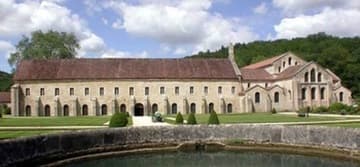
The lovely, warm-hued Abbey of Fontenay is well worth a visit. The buildings are pristinely restored and the grounds are beautifully landscaped. A clear flowing stream with splashing ducks welcome you at the parking lot. Many medieval buildings can be seen, including the church, cloister, dormitory, abbot's lodging, bakery, infirmary and more.
The abbey church, built from 1139 to 1147, is the oldest Cistercian church remaining in France and one of the best examples of the Cistercian Romanesque architectural style.
Stairs in the south transept lead up to the monks' dormitory, a long room where they slept communally on straw mattresses, separated by low partitions. They slept fully dressed, both for warmth (the room was not heated) and to be ready for midnight services. It has a beautiful roof of hand-hewn beams of Spanish chestnut, dating from the late 15th century.
Back in the church, a small door next to the dormitory stairs leads into the beautiful cloister. Here the monks spent most of their free time, usually reading, working or praying. Some capitals are decoratively carved, but only with restrained stiff-leaf designs.
A door from the east side of the cloister leads into the Chapter House, where the monks gathered each day to hear a chapter from St. Benedict's Rule and conduct the business of the day. The room is rib-vaulted and has two small annexes at each end; one was probably a sacristry and the other a parlor.
Next to the west end of the church are buildings that housed the abbey's non-human occupants. The round building is a dovecote, for keeping pigeons. It dates from the 12th or 13th century and the wall is more than a meter thick. Across the path at the edge of the complex, two stone statues of dogs mark the site of the kennel, where the hunting dogs of the Dukes of Burgundy were kept.
The Cistercians were well-known for their expertise in water engineering, and here at Fontenay it was used to especially impressive ends. In a building at the south side of the complex is a water-powered forge, recently reconstructed based on the original devised in 1220. The monks extracted iron ore from stone quarried on the hill above the monastery, then used the forge to make iron tools to be sold in the region. According to a wall plaque, this was the first metallurgical factory in Europe and the place of invention of the hydraulic hammer, which became the basis of industrial manufacturing in Europe. Several mechanical models demonstrate how the machine works.
Highlights from Sacred Destinations
Highlights from Sacred Destinations
Advertisement
Advertisement
Advertisement
Where on earth