Highlights from Sacred Destinations
Explore the site
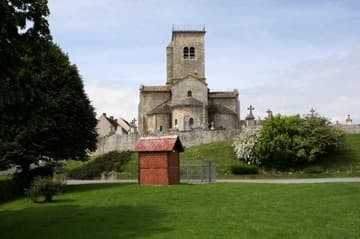
Gourdon's parish church crowns the top of the hill at the edge of the village, and fine views over the southern Burgundian countryside can be had from the churchyard and points nearby.
/ France / Gourdon Church
Virgin Mary (Assumption)
Standing atop a hill in the center of a Burgundian village, Gourdon Church has a pale-pink interior with restored Romanesque frescoes and carved capitals.
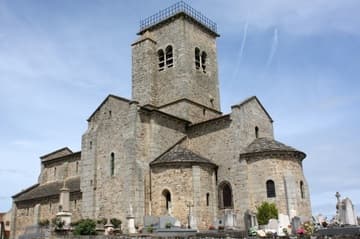
The Église Notre-Dame de l'Assomption (Church of the Assumption of Our Lady) in Gourdon is an attractive Romanesque parish church of the 12th century. Standing atop a hill in the center of the Burgundian village, it has a pale-pink interior with restored Romanesque frescoes and charming carved capitals.
Gourdon stands on the site of an ancient Gallo-Roman hill fortress. The village first appears in written history in the 6th century AD, with a mention in the De Gloria confessorum by Gregory of Tours - the author says he met with a hermit from the monastery of Gourdon in 570. The records are silent again until a document of 1104, in which a priest from Gourdon was present at a transaction made in the convent of Marcigny.
In the later Middle Ages, several documents discuss the status of the relationship between Gourdon and Le Puy en Velay. In the 16th century, it was decided that the canons of Le Puy could rightly be called "priors of Gourdon."
The more recent history of Gourdon Church has focused on preservation and restoration of its magnificent art and architecture. It was classified a historical monument in 1900. The first campaign to restore the frescoes began in 1971 under Mr. Raffin and continued under Mr. Deleval (1987-88) and Mr. Takahashi (1991). The church remains in use as the village's parish church.
The village first appears in written history in the 6th century AD, with a mention in the De Gloria confessorum by Gregory of Tours - the author says he met with a hermit from the monastery of Gourdon in 570.
The records are silent again until a document of 1104, in which a priest from Gourdon was present at a transaction made in the convent of Marcigny.
Gourdon's parish church crowns the top of the hill at the edge of the village, and fine views over the southern Burgundian countryside can be had from the churchyard and points nearby. A cemetery with modern graves stretches away to the east, while an old well stands in the tiny plaza at the west.
After the grey, castle-like appearance of the church exterior, the nave comes as a pleasant surprise. It has a soft pink hue and a high, attractive vault. The architecture of the nave is actually rather unique for Burgundy - it has groin vaulting as well as three levels (arcade, triforium and clerestory). The round arches of the vault are supported by pillars and engaged columns.
Every column in the nave is topped with a rustically carved capital. Most of the capitals depict mythical creatures in various poses, but a few human figures make an appearance. Towards the front of the nave on the left, a naked women with snakes grawing on her breasts warns against lust.
In the choir, the main attraction are the Romanesque frescoes, which are quite faded and have been significantly restored. Red is the dominant hue, nicely matching the pale pink of the walls. In the apse, Christ in Majesty sits on a throne within a mandorla, surrounded by stylized versions of the Four Evangelists. Between the windows below are busts of two unknown abbots.
The left (north) wall of the choir has frescoes of apostles (moving towards Christ in the apse), the Annunciation, and the Nativity of Christ. Most of the frescoes on the bottom part of the wall have been lost, but the sole survivor is a charmingly slim elephant with cow-like hooves and a tiny trunk. It was painted, of course, by someone who had never seen an elephant. On the right (south) side, there is a bust of Christ between two pilgrims of Emmaus and more apostles up top. There are more frescoes in the apse of the south chapel.
Highlights from Sacred Destinations
Highlights from Sacred Destinations
Advertisement
Advertisement
Advertisement
Where on earth