Highlights from Sacred Destinations
Explore the site
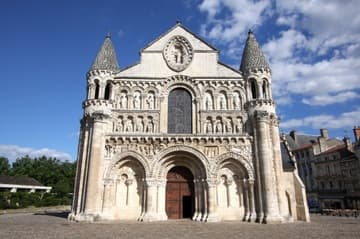
The west front of Notre-Dame-la-Grande (c.
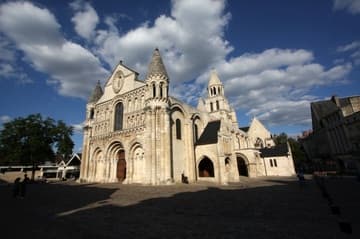
/ France / Notre-Dame-La-Grande
Virgin Mary · c. 1075-1150
This unique Romanesque-Byzantine church of the 11th and 12th centuries has one of the finest Romanesque faces in France, covered in a jumble of carvings of saints and biblical scenes.
The Église Notre-Dame-la-Grande in Poitiers is a magnificent Romanesque-Byzantine church from the 11th and 12th centuries. Its wide facade is flanked by pinecone-shaped towers and covered in carvings of saints and biblical scenes.
The early history of this fascinating church is something of a mystery, but the first recorded mention of it dates from 924 AD. The present Notre-Dame-la-Grande is thought to date from the late 11th century to the middle of the 12th century. The facade dates from the latter period. The church is not particularly large, so the name probably indicates there were less impressive churches dedicated to Our Lady in medieval Poitiers.
Since at least 1428, every Easter Monday a miraculous statue of the Virgin Mary known as the "Virgin of the Keys" was carried in procession around the ramparts of the town. This statue survives today and is kept in the choir of the church.
The church was thoroughly cleaned and restored in 1996; its stone is now a gleaming white. Interestingly, most of the dirt and damage to the facade was caused less by pollution and pigeon droppings than by the salt from the nearby market, which seeped into the ground and up the facade.
The early history of this fascinating church is something of a mystery, but the first recorded mention of it dates from 924 AD.
Since at least 1428, every Easter Monday a miraculous statue of the Virgin Mary known as the "Virgin of the Keys" was carried in procession around the ramparts of the town.
The west front of Notre-Dame-la-Grande (c.1150) is one of the finest Romanesque facades in France. It is flanked by turrets topped with conical spires, which, along with the rich sculpture, are the hallmarks of Poitou Romanesque architecture.
The sculpture of the west front is divided into three tiers. The middle and top tiers are a jumbled array of carved saints, prophets, creatures and foliage. The bottom tier tells the story of Jesus from right to left, based on The Drama of the Prophets, a fifth-century sermon. From left to the right, the carvings depict:
In the middle tier, the word of God is spread by the Twelve Apostles (eight seated below; four standing above) and two local bishop-saints on either end: Hilary and Martin. Only a few apostles still have distinguishable faces; among them is St. Peter, with keys in his left hand. The top tier features a richly-carved oval medallion of Christ in Glory (now headless), surmounted by the sun and moon and surrounded by the symbols of the Four Evangelists. There are interesting carvings of creatures and foliage in thearches at eye-level, too.
The interior consists of a dark, barrel-vaulted nave with no clerestory, narrower side aisles, a transept crossing topped with a tower, a small choir, and a groin-vaulted ambulatory with radiating chapels. A faded 12th-century fresco survives on the choir vault. The rest of the murals, which cover the nave columns and other surfaces with garish geometrical designs, date from the 19th century. There is only one narrative capital, which depicts the Ascension of Christ with angels.
Highlights from Sacred Destinations
Highlights from Sacred Destinations
Advertisement
Advertisement
Advertisement
Where on earth