Highlights from Sacred Destinations
Explore the site
The abbey is located at about 3,500 feet above sea level in the richly forested Pyrenees mountains.
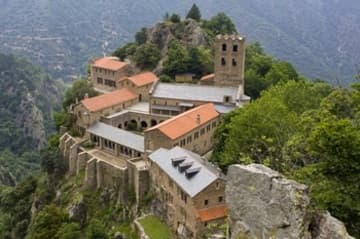
/ France / St-Martin-Du-Canigou Abbey
St. Martin · 11th C
Boasting a spectacular location in the Pyrenees mountains of southern France, the 11th-century abbey of Saint-Martin-du-Canigou has a wonderful collection of Romanesque carvings.
Boasting a spectacular location in the Pyrenees mountains of southern France, the abbey church of Saint-Martin-du-Canigou is a Romanesque treasure from the early 11th century. In addition to its ancient architecture, it is notable for its collection of original 13th-century capitals depicting a variety of imaginative subjects.
Construction on the Abbey of Saint Martin probably began in 1005, the year it was founded by Count Guifre de Cerdanya. The elder brother of Oliba, who was abbot of the nearby Saint-Michel-de-Cuxa, the count eventually became a monk himself in Saint-Martin-du-Canigou. The completion date for the abbey church is usually given as 1009 - one thousand years ago. Benedictine monks were invited to take up residence in the new abbey.
The abbey remained active until it was dissolved in 1783. Thereafter it was abandoned, lying neglected and forgotten throughout the 1800s. Many of the abbey buildings fell into ruin, but happily the church and its tower remained standing in 1902, when restoration work began. The restoration project was led by Mgr de Carsalade du Pont, Bishop of Perpignan. Today, the abbey is active once again, as home to the Community of the Beatitudes.
Construction on the Abbey of Saint Martin probably began in 1005, the year it was founded by Count Guifre de Cerdanya.
The completion date for the abbey church is usually given as 1009 - one thousand years ago.
The abbey is located at about 3,500 feet above sea level in the richly forested Pyrenees mountains. Accessible only by a scenic paved path that winds through the woods, it offers a unique atmosphere along with its rich history and art. Upon arrival at the abbey, head to the visitor's center to purchase a ticket for the next guided tour. A resident monk or nun will lead the tour in French, with translations in several other languages provided as handouts.
Visitors approach the abbey from the east side, which provides a view of the handsome chevet from below. Like many early Romanesque churches, it has a central apse flanked by two smaller apses decorated with Lombard bands, and a triangular pediment above. Another apse extends to the south, as part of a small chapel. The bell tower is attached to the north side of the church. It is built in the distinctive Roussillon style, with a stout square shape, multiple tiers of round-headed openings, and a crenellated top.
The church is built on two levels, both having the same floor plan of three aisles and no transept. There is a nice view of the cloister and the mountains from a spacious open platform next to the upper church. Its west facade is plain, with a round-headed door and a small window over each aisle.
The round barrel vaults of the upper church are supported on a low colonnade; a tall transverse arch separates the nave from the apse. The capitals are decoratively carved, most with a simple plant-inspired design, but a wolf and a lion also appear. The church is dimly lit, with the only illumination coming from windows in the south aisle. It is reserved for prayer throughout the day, so visitors are asked to be silent and not take any pictures inside.
The lower church or crypt is even more atmospheric and ancient. Although most of its present form is contemporary with the upper church (11th century), the east end of the crypt is thought by some to date from Carolingian times. The guide will point out primitive columns with carved capitals that were discovered inside the square masonry pillars, leading to the hypothesis that the ancient crypt had to be reinforced when the upper church was built.
Few of the abbey buildings survived the 19th-century neglect intact. This includes the two-story cloister, which has been rebuilt on its original site. It does not reflect its original form very closely, but is an attractive space filled with a rose garden. The south side of the cloister has been reconstructed on a platform that faces the mountains, providing spectacular views. Here visitors can admire the columns and capitals that once decorated the upper cloister, which have been thoughtfully placed on the outside (south side) of the gallery so they receive more light.
Except for two dated to the 12th century (they are taller than the rest and depict lions and birds), the capitals were carved in the 13th century in the Romanesque style. Dispersed after the Revolution, they were recovered from various owners in the 20th century.
The capital sculptures depict a fascinating array of subjects with great liveliness, including real and mythical animals, human figures, a half-naked woman symbolizing Lust, an abbot apparently being condemned to hell, and an especially fine depiction of an abbot celebrating Mass with his monks, who carry a processional cross, candle and censer. There are a few more carved capitals on the south side of the upper church by the stairs, including a mermaid who has lost all but her double tail and hands.
For a fine view of the abbey from above, head south from the gathering area below the church and up a small trail marked by signs warning about danger. The danger is due to the lack of any fence around the small platform, which looks out over a steep cliff. But the platform is mostly smooth and roomy enough for a few adults to enjoy the view without taking any excessive risks, and the view is exceptional. Just be careful not to trip over a rock!
Highlights from Sacred Destinations
Highlights from Sacred Destinations
Advertisement
Advertisement
Advertisement
Where on earth