Highlights from Sacred Destinations
Explore the site
The new Basilique de St-Martin is neo-Byzantine in style and is much smaller than its great medieval predecessor.
/ France / Basilica of St. Martin
St. Martin · 1886-1924
This Neo-Byzantine basilica stands on the site of the tomb of St. Martin of Tours. Next to it are two Romanesque towers and a Renaissance cloister from an earlier basilica.
The Basilique de St-Martin in Tours is a neo-Byzantine basilica on the site of previous churches built in honor of St. Martin, bishop of Tours in the 4th century. Next to it are two Romanesque towers and a Renaissance cloister surviving from the earlier basilica.
St. Martin was born in modern-day Hungary in about 316. His father was an officer in the Roman army, and Martin accompanied him to Pavia in Italy at an early age. When he reached adolescence, he was enrolled in the army himself and soon transferred to Amiens in France. By this time, Martin had converted to Christianity.
It was in Amiens that the famous legend of the cloak occurred, which is depicted in stained glass windows and carved on capitals throughout the region. At the gates of the city, one very cold day, Martin met a shivering and half-naked beggar. Moved with compassion, he divided his coat into two parts and gave one to the poor man.
Martin was baptised soon after, and with in a couple years his conscience would no longer allow him to fight in the army. After securing his release, Martin headed straight for Poitiers to become a disciple of the famous Bishop Hilary. Martin thereafter spent his time battling Arianism, preaching the Gospel in western Gaul, and living as a hermit at a deserted place called Ligugé.
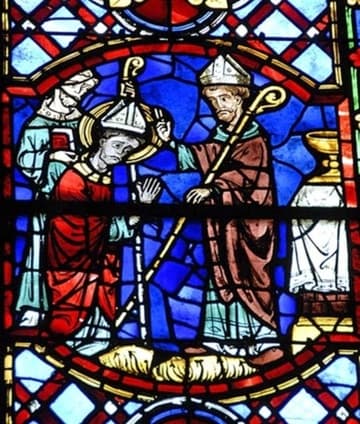
When the bishop of Tours died in 371, the city's clergy begged Martin to take the position. But Martin strongly refused, desiring the solitary life above all else. So the town took desperate measures - Rusticius, a rich citizen of Tours, went and begged Martin to come to his dying wife to prepare her for death. Martin followed him immediately, but had hardly entered the city when, in spite of the opposition of a few ecclesiastical dignitaries, popular acclamation forced him to become Bishop of Tours.
As expected, Martin was an excellent bishop, but he did not change his preferred way of life - he lived outside the city across the Loire at Marmoutier, where a monastery soon developed around him. Martin died in 397 at the age of about 81 in Candes, and his body was brought back to Tours.
Martin's remains were enclosed in a stone sarcophagus, above which his successors, St. Britius and St. Perpetuus, built first a simple chapel, and later a basilica (466-72). St. Euphronius, Bishop of Autun and a friend of St. Perpetuus, sent a sculptured tablet of marble to cover the tomb. This Early Christian basilica burned down along with many other churches in 988.
A larger Basilica of St. Martin was constructed in 1014, which burned down in 1230. This was rebuilt as an even larger 13th-century Romanesque basilica, which became the center of great national pilgrimages and a stop on the way to Santiago. Martin's cult was very popular throughout the Middle Ages and a multitude of churches and chapels have been dedicated to him.
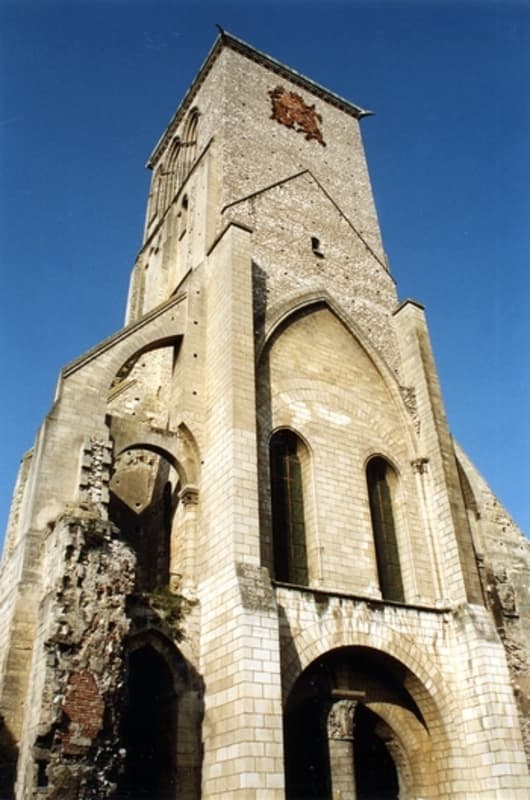
In 1562, Huguenots (French Calvinists) sacked the Basilica of St. Martin from top to bottom, especially destroying the tomb and relics of Martin. The church was restored by its canons, but then was completely demolished in 1793 during the Revolution. All the remained of the basilica was the two towers which are still standing. To ensure the basilica could not be rebuilt, the atheistic municipality caused two streets to be opened up on its site.
In December 1860, excavations located the site of St. Martin's tomb, of which some fragments were discovered. A new basilica to house these relics was constructed by Mgr Meignan, Archbishop of Tours, from 1886-1924. Martin's tomb is still a place of pilgrimage for the faithful.
Martin was born in modern-day Hungary in about 316.
When the bishop of Tours died in 371 , the city's clergy begged Martin to take the position.
The new Basilique de St-Martin is neo-Byzantine in style and is much smaller than its great medieval predecessor. Next to it stand the only remains of the Romanesque basilica: the Tour de Charlemagne and the western clock tower.
The relics and shrine to St. Martin are in the basilica's crypt, the walls of which are carved with hundreds of votive prayers dedicated to the saint.
Highlights from Sacred Destinations
Highlights from Sacred Destinations
Advertisement
Advertisement
Advertisement
Where on earth