Highlights from Sacred Destinations
Explore the site
In the entrance hall, visitors are greeted by " The Dance of Death " (Totentanz), a large fresco (2 meters high, 22 meters long) dating from about 1485.
/ Germany / Marienkirche
Virgin Mary · 14th C
An attractive Protestant church on the east side of Berlin, St. Mary's Church houses a 15th-century fresco of "The Dance of Death" and other artworks.
The Marienkirche (St. Mary's Church) in Berlin is a 14th-century Protestant church. One of the oldest churches in Berlin, it houses a large medieval fresco of "The Dance of Death" and other artworks.
Begun around 1270, the Marienkirche was completed in the early 14th century. St. Mary's was designed as an early Gothic hall church; it received the front tower in the 15th century and a Baroque dome atop the tower in 1790. The dome was designed by Carl Gotthard Langhans, the architect of the Brandenburg Gate.
The Marienkirche became Protestant after the Reformation, in 1539. It was damaged but not destroyed during World War II and fully restored in 1950. Many artworks from nearby destroyed churches were moved into the Marienkirche, where they remain today.
Begun around 1270, the Marienkirche was completed in the early 14th century .
The Marienkirche became Protestant after the Reformation, in 1539.
In the entrance hall, visitors are greeted by "The Dance of Death" (Totentanz), a large fresco (2 meters high, 22 meters long) dating from about 1485. Painted during the plague epidemics of the Dark Ages, the fresco wraps around the entrance hall and depicts all classes of society dancing with death, moving at a slow and dignified gait.
The fresco was discovered in 1860 under layers of paint and in quite poor condition. Fundraising is currently underway to restore its original colors: for €2.50, visitors can add a colored mosaic tile to a replica of the fresco.
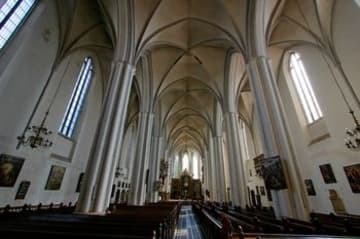
The nave of St. Mary's has vaulted ceilings, two side aisles and a central pulpit. After the war, the pulpit was moved forward from the second pillar to the fifth pillar and several pews were realigned to face it.
There are a number of notable artworks displayed throughout the church, including the following:
Outside the church on the north side is a 3.5-meter bronze statue of Martin Luther on a granite pedestal. Originally set up at the New Market in 1893, it was sculpted by M.P. Otto (sculptor of the Humboldt monuments at the University) and Robert Toberentz. For the 500th birthday of Luther in 1983, the statue was placed at its present location next to St. Mary's.
Highlights from Sacred Destinations
Highlights from Sacred Destinations
Advertisement
Advertisement
Advertisement
Where on earth