Sacred Destinations

/ Germany / Erfurt Cathedral

Erfurt Cathedral

Virgin Mary

Erfurt Cathedral

50.9759° N · 11.0237° E|Erfurt, Germany
This Gothic cathedral with Romanesque parts is an impressive edifice that uses its unique sloping site to full advantage. Inside are many important art masterpieces.

Erfurt Cathedral (German: Dom, Mariensdom, or Domberg St Marien) is an impressive Gothic cathedral with some Romanesque parts situated on a hillside in Erfurt. Inside are many important art masterpieces.

01

History

Most of the Dom is Gothicand dates from the 14th and 15th centuries, but the lower parts of its huge towers are Romanesque and belonged to a church built on this site for Bishop Boniface in 742.

On April 3, 1507, Martin Luther was ordained a priest in Mariensdom (see Luther in Erfurt and The Luther Trail).

Timeline of Erfurt CathedralAuto-play · hover to pause
742 CEMost of the Dom is Gothic and dates from the 14th and 15th centuries

Most of the Dom is Gothic and dates from the 14th and 15th centuries , but the lower parts of its huge towers are Romanesque and belonged to a church built on this site for Bishop Boniface in 742 .

2000 BCE1 CE2000 CE
1507 CEOn April 3, 1507, Martin Luther was ordained a priest in Mariensdom

On April 3, 1507, Martin Luther was ordained a priest in Mariensdom (see Luther in Erfurt and The Luther Trail ).

02

What to see

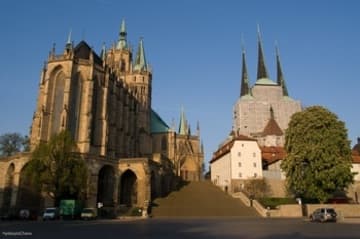
The wide stairs that lead dramatically from the Domplatz to the main entrance of the cathedral provide a good view of the 14th-century Gothic presbytery, which is supported by a massive fortress-like substructure known as the Kavaten (late 13th century).

The choir and transepts were built on top of the Kavaten in the mid-14th century in a pure High Gothic style, and the highly decorated triangular porch was added soon after. The porch features vivid statues illustrating the parable of the Wise and Foolish Virgins.

The Dom was completed in the 15th century with the addition of the spacious hall nave, whose very German appearance contrasts with the French influence evident elsewhere.

The Dom's central tower houses the Maria Gloriosa bell, cast by Gerhard Wou in 1497. It was the largest bell cast during the Middle Ages and, at 2.5 m (8 feet) in diamater, it is still the world's largest medieval free-swinging bell. Guided tours provide a closeup view of the great bell, but before you take to the stairs, note that the tower does not offer a view over the city.

The interior has well-preserved Gothic decorations and rich furnishings. Of particular note are the 14th- and 15th-century stained glass windows, which are one of the most impressive sets in Germany.

Also of note are the Gothic choir stalls (1370), "Wolfram," a Romanesque (c.1160) bronze candelabra shaped like a man, and a stucco altar of The Enthroned Madonna with Saints (mid-12th-century).

Items of interest in the nave include a small altar of The Madonna and Child with SS Catherine and Barbara by Lucas Cranach, and the tomb of the supposedly bigamous Count of Gleichen and his wives.
Highlights from Sacred Destinations

Explore the site

The wide stairs that lead dramatically from the Domplatz to the main entrance of the cathedral provide a good view of the 14th-century Gothic presbytery , which is supported by a massive fortress-like substructure known as the Kavaten (late 13th century).
Explore the site

Highlights from Sacred Destinations

Look more closely

The choir and transepts were built on top of the Kavaten in the mid-14th century in a pure High Gothic style, and the highly decorated triangular porch was added soon after.
Look more closely

Advertisement

Advertisement

Advertisement

03

Gallery

5 photographs
04

Location

Where on earth

50.9759° N · 11.0237° EErfurt, Germany
Open in Google Maps ↗