Highlights from Sacred Destinations
Explore the site
The Romans wanted the architecture to express the magnificence and might of the emperor, and the sheer size of the great basilica still impresses.
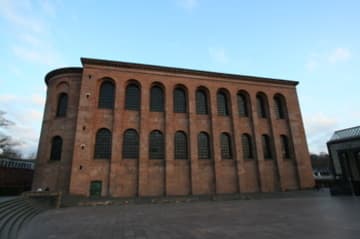
/ Germany / Aula Palatina
Sacred site · 310
Built in 310, this huge brick structure was the throne hall of Constantine and other Roman emperors. Today it is used as a Protestant church.
The Aula Palatina (Palatinate hall), also known as the Konstantin Basilika, was built in Trier in 310 AD.
The long, high-ceilinged brick structure was the throne hall of the Roman emperor until the destruction of the city by Germanic tribes. The invaders built a settlement inside the roofless ruin. In the 12th century, the apse was converted into a tower to accommodate the Archbishop of Trier.
In the 17th century, the Aula Palatina was integrated into the newly-built imperial palace (Residenz) and its eastern wall was partly demolished. During Napoleonic and Prussian times, the hall served as army barracks. The Prussian king Friedrich Wilhelm IV eventually ordered its reconstruction, and it was restored again after bomb damage in 1944.
Since 1856, the Roman basilica has served as the Protestant Church of St. Savior.
Since 1856, the Roman basilica has served as the Protestant Church of St.
The Prussian king Friedrich Wilhelm IV eventually ordered its reconstruction, and it was restored again after bomb damage in 1944.
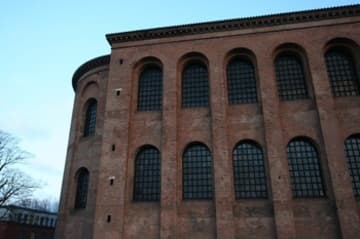
The Romans wanted the architecture to express the magnificence and might of the emperor, and the sheer size of the great basilica still impresses. The elongated, rectangular brick building is 220 feet long, 90 feet wide and 98 feet high with a vast semi-circular apse. It is the largest surviving single-room structure from Roman times.
This depth is magnified by an optical illusion - both the windows of the apse as well as the niches underneath become progressively smaller towards the middle, thus enhancing the impression of length.
Now nearly empty and austere inside, the Konstantin Basilika was originally embellished with colorful marble inlay, golden mosaics, and statues. It was made comfortable by a hollow-floor heating system. but all this splendor and technology were destroyed (in the 5th century) by the Germanic Franks,
Highlights from Sacred Destinations
Highlights from Sacred Destinations
Advertisement
Advertisement
Advertisement
Where on earth