Highlights from Sacred Destinations
Explore the site
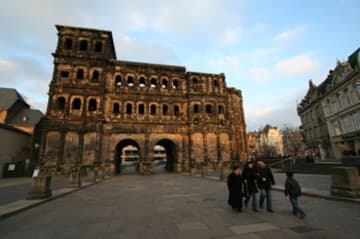
1,700 years after its construction, the Porta Nigra is still impressive at 118 feet long, 70.
/ Germany / Porta Nigra
Sacred site · c. 180
The impressive "Black Gate" sight is a 2nd-century Roman city gate. It owes its survival to its use by a revered hermit monk and subsequent transformation into a two-story church.
The Porta Nigra is a magnificent 2nd-century Roman city gate in Trier, Germany. It was given its name (which means "black gate") in the Middle Ages because of its weathered color.
The oldest defensive structure in Germany, the Porta Nigra was erected in about 180 AD when the Roman city was surrounded by walls. Trier was a Roman colony from the 1st century AD and then a great trading centre beginning in the second century. It became one of the imperial capitals under the Tetrarchy at the end of the 3rd century, and became known as the "second Rome."
The Porta Nigra is the only one of four Roman gates that still stands in Trier; the others were gradually pillaged for their stone and iron. The Porta Nigra survived because it was used as the humble residence of a hermit monk named Simeon for seven years (1028-35). After his death he was buried in the gate and the structure was transformed into the two-story Church of St. Simeon (lay church on the bottom, monastery church on top).
Napoleon destroyed the church in 1803, but the 12th-century Romanesque apse survived and the entire structure has been restored to its medieval appearance.
The oldest defensive structure in Germany, the Porta Nigra was erected in about 180 AD when the Roman city was surrounded by walls.
The Porta Nigra survived because it was used as the humble residence of a hermit monk named Simeon for seven years (1028-35).
1,700 years after its construction, the Porta Nigra is still impressive at 118 feet long, 70.5 feet wide and 90 feet high. The entire structure is made without mortar - the sandstone blocks are connected only by iron rods. The stone blocks weigh as much as six metric tons each.
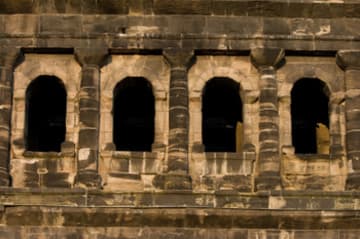
Two gateways lead into a small inner courtyard, where unfortunate intruders would be trapped and covered in tar. Above are two tiers of defense galleries with large open windows. It is flanked by two towers, a four-story western tower and the three-story unfinished eastern tower.
Inside, an empty apse at the east end and carvings of church fathers like Irenaeus, Ambrose and Jerome recall the Porta Nigra's use as a church.
Next door to the Porta Nigra is the Simeonstift, the 11th-century monastery built to go along with St. Simeon's Church in the gate. The cloisters can be toured for free. The main monastery building houses the Stiftsmuseum, which has some moderately interesting displays on the history of the city, but few religious artifacts.
Highlights from Sacred Destinations
Highlights from Sacred Destinations
Advertisement
Advertisement
Advertisement
Where on earth