Highlights from Sacred Destinations
Explore the site
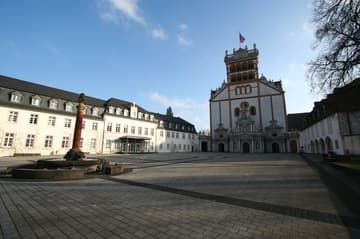
Matthias Abbey Church overlooks a spacious plaza surrounded by attractive white buildings.
/ Germany / St. Matthias Abbey
Sacred site · 1148
This fine 12th-century church, part of an active Benedictine abbey, houses the relics of St. Matthias, the apostle who was chosen to replace Judas Iscariot. It is still visited by many pilgrims.
St. Matthias Abbey Church (Abtei St. Matthias) in Trier houses the relics of St. Matthias, the apostle who was chosen to replace Judas Iscariot. The lovely 12th-century church, part of an active Benedictine abbey, is still visited by many Catholic pilgrims.
Acts 1:26 reports that Matthias was chosen to replace Judas because he was a witness to the Resurrection. According to early Christian writers (Clement of Alexandria, Jerome, Eusebius, and others), Matthias was one of the 72 disciples Jesus sent out during his ministry. He is said to have lived an ascetic life in order to make his spirit subject to the Crucified One.
According to tradition, Matthias preached in Cappadocia, Turkey, and was martyred at Colchis, on the eastern coast of the Black Sea. He was sentenced to stoning but this method miraculously failed, so he was beheaded.
St. Helena, Constantine's mother, is said to have brought St. Matthias' relics from Jerusalem and divided them between the Basilica of St. Mary Major in Rome and this abbey church at Trier.
In Trier, the monks enshrined the relics in a beautifully carved tomb before the altar. Records dating back to the 5th century indicate the existence of a monastery here, on the graves of the first Christian evangelists sent to Trier.
Both monastery and church were rebuilt after the disaster of Maundy Thursday, 882, when the Normans conquered and destroyed Trier. Most of the abbey church that stands today dates from the Romanesque period (1127-1160). The church was consecrated in 1148 by Pope Eugene III.
Both monastery and church were rebuilt after the disaster of Maundy Thursday, 882, when the Normans conquered and destroyed Trier.
Most of the abbey church that stands today dates from the Romanesque period (1127-1160).
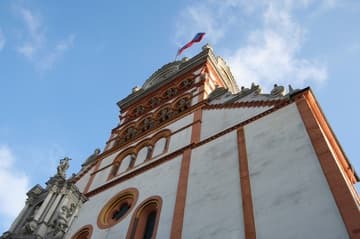
St. Matthias Abbey Church overlooks a spacious plaza surrounded by attractive white buildings. The Romanesque church is plastered white and painted with orange accents.
A Baroque facade has been added to the lower west front, which centers on a sculpture of St. Matthias holding an axe and an open book with a reference to John 15:14: "You are my friends if you do what I command."
The church has a "westwork" at the west end, with a tower of blind arcades and a gallery inside. There are two Romanesque towers at the east end. The Romanesque nave has square piers and simple round arches with no decoration, illuminated by small windows in the clerestory.
This simplicity highlights the impressiveness of the ribbed vaulting, which continues into the westwork and the transepts. Painted roof bosses of bishops, angels and saints adorn each vault intersection - bring binoculars or a zoom lens for a good look. The side aisles have a simple Romanesque groin vault.
The Tomb of the Apostle, with a barefooted marble effigy of Matthias, lies at the front of the nave surrounded by tall candles. The relics are beneath the tomb in a small, plain sarcophagus, which is accessible from the crypt.
The crypt also contains two large sarcophagi labeled with Latin names. In the east end of the crypt, look for an interesting roof boss of a bishop defeating a demon.
South of the church is the Benedictine Abbey of St. Matthias, with a 13th-century refectory and dormitory and 18th-century main building. Early Romanesque cloisters have been partly restored.
The abbey museum displays a significant collection of artifacts, paintings and historical documents.
Highlights from Sacred Destinations
Highlights from Sacred Destinations
Advertisement
Advertisement
Advertisement
Where on earth