Highlights from Sacred Destinations
Explore the site
The church is built on the plan of a Greek cross (a cross with equal arms), with a narthex on the west side.
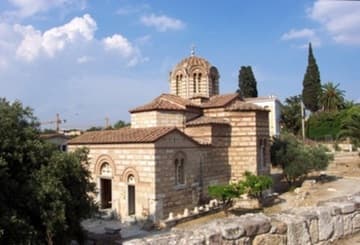
/ Greece / Agii Apostoli Church
Holy Apostles · c.1000
Located on the Ancient Agora of Athens, this Byzantine church dates from the 10th century. It is one of the oldest churches in the city.
Dating from the late 10th century, Agii Apostoli (Holy Apostles) Church in the Ancient Agora of Athens played a significant role in the development of Byzantine architecture.
This site originally hosted a 2nd-century Nymphaeum, a monument honoring the nymphs that usually included a fountain. The Church of the Holy Apostles was built on its foundations in the last quarter of the 10th century, to cater to the expanding community in this part of the city. It was the beginning of a period of prosperity in Athens that lasted until the conquest of the Franks in 1201.
The church was slightly expanded during three more building phases: the first added square niches at either end of the narthex; the second expanded the narthex to the west; and the third removed the narthex supports to create a longer nave.
Agii Apostoli suffered damage during the war over Athens between the Ottomans and Venetians around 1687 and it was repaired in the 18th century.
Extensive restoration work was carried out in 1876-82, which unfortunately included unattractive extensions that altered the church's original form. These alterations were reversed during a restoration and excavation project carried out between February 1954 and September 1956. The present form of the church is close to that of the 10th-century original.
It was the beginning of a period of prosperity in Athens that lasted until the conquest of the Franks in 1201.
Agii Apostoli suffered damage during the war over Athens between the Ottomans and Venetians around 1687 and it was repaired in the 18th century.
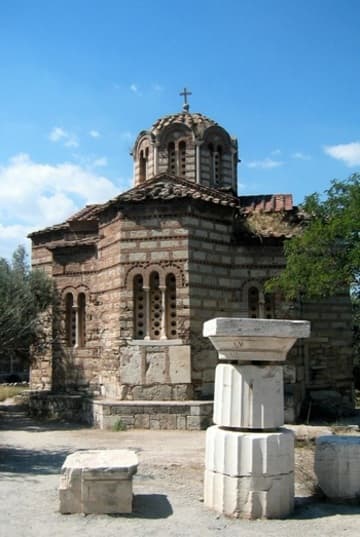
The church is built on the plan of a Greek cross (a cross with equal arms), with a narthex on the west side. Each arm ends in a semi-circular niche (or apse) and smaller niches are placed on either side of each apse. A dome rests on four pillars in the central crossing; it is the oldest example of the "Athenian type" of Byzantine dome in the city.
The church contributed to the development of Byzantine architecture by its successful combination of a central plan with a cross-in-square design.
The facade of the west narthex is decorated with brick Kufic patterns, which were restored in the 20th century based on similar examples. The three entrance portals are topped with round tympana with punched star designs.
A Byzantine sarcophagus found nearby has been placed inside the church and burials were discovered beneath the floor of the nave and narthex. There are fragments of frescoes throughout the church, most of which are from the 17th or 18th century and considered of mediocre quality. Other wall paintings found in the vicinity have been posted inside the church as well.
Highlights from Sacred Destinations
Highlights from Sacred Destinations
Advertisement
Advertisement
Advertisement
Where on earth