Highlights from Sacred Destinations
Explore the site
Politically, the peninsula is essentially self-governed.
/ Greece / Mount Athos
Sacred site · founded 963
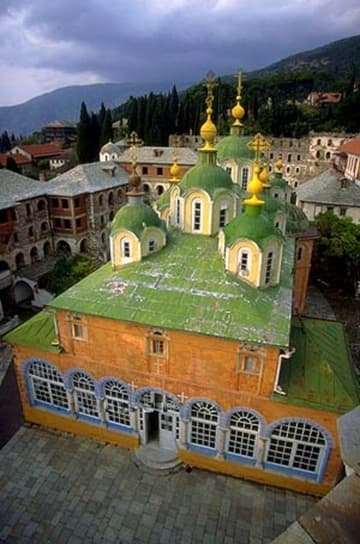
This mountainous peninsula in northern Greece is home to 20 Eastern Orthodox monasteries, the earliest of which was founded in 963 AD.
Mount Athos (Greek Άγιο Όρος, "Holy Mountain"), is a mountainous peninsula in northern Greece. It is home to 20 Eastern Orthodox monasteries and forms an autonomous state under Greek sovereignty. Only monks are allowed to live on Athos and the current population numbers around 1,400.
The Mount Athos peninsula is the easternmost "leg" of the larger Chalkidiki peninsula. It protrudes into the Aegean Sea for some 60 km at a width between 7 to 12 km. It covers an area of about 390 km², with the actual Mount Athos and its steep, densely forested slopes reaching up to 2,033 m.
The seas around the end of the peninsula can be dangerous. Xerxes I had a channel excavated across the isthmus to allow the passage of his invasion fleet in 483 BC.
Mt. Athos as a monastic community was formally founded in 963, when the monk Athanasios established the monastery of Great Lavra, which is still the largest and most prominent of the 20 monasteries. It enjoyed the protection of the emperors of the Byzantine Empire during the following centuries and its wealth and possessions grew considerably.
In the 13th century, the Fourth Crusade brought new Roman Catholic overlords which forced the monks to seek protection from Pope Innocent III until the restoration of the Byzantine Empire. It was raided by Catalan mercenaries in the 14th century, a century that also saw the theological conflict over the hesychasm practised on Mount Athos and defended by Gregory Palamas.
The Byzantine Empire collapsed in the 15th century and the Muslim Ottoman Empire took over. The Turks taxed the monasteries heavily, but for the most part left them alone.
The population of monks and their wealth declined over the next centuries, but was revitalized around the 19th century by the donations and new arrivals from other Eastern Orthodox countries, such as Russia, Bulgaria, Romania and Serbia. Each country came to exert its influence on individual monasteries.
In 1912, during the First Balkan War, the Ottomans were forced out and after a brief conflict between Greece and Russia over sovereignty, the peninsula formally came under Greek sovereignty after World War I.
In modern times, Mount Athos monasteries have repeatedly been struck by wildfires, including in August 1990 and in March 2004. Due to the secluded locations of the monasteries and the unavailability of suitable firefighting gear, the damages inflicted by these fires are often considerable.
Athos as a monastic community was formally founded in 963, when the monk Athanasios established the monastery of Great Lavra, which is still the largest and most prominent of the 20 monasteries.
In 1912, during the First Balkan War, the Ottomans were forced out and after a brief conflict between Greece and Russia over sovereignty, the peninsula formally came under Greek sovereignty after World War I.
Politically, the peninsula is essentially self-governed. It consists of 20 main monasteries plus the capital city and administrative centre, Karyes, which is also home to a Greek governor. The 20 sovereign monasteries, in the order of their place in the hierarchy, are:
In addition to the monasteries there are 12 sketes, smaller communities of monks, as well as many (solitary) hermitages throughout the peninsula. The main sketes are:
In order to reduce temptation, women, beardless boys and eunuchs are completely barred from the peninsula. Even female domestic animals (with the exception of cats who control rodents and hens who provide the yolk needed for the paint used in iconography) are forbidden.
However, during the Greek Civil War, Athos did shelter refugees including women and girls, and the rule against beardless boys is not strictly enforced.
Highlights from Sacred Destinations
Highlights from Sacred Destinations
Advertisement
Advertisement
Advertisement
Where on earth