Highlights from Sacred Destinations
Explore the site
Ancient Akrotiri provides a rare glimpse into urban life in the Minoan period.
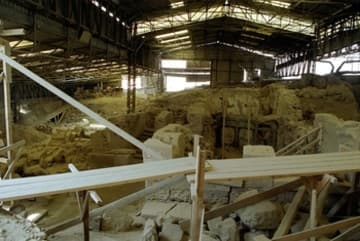
/ Greece / Ancient Akrotiri
Sacred site · c. 20th-17th cent. BCE
Known as the "Minoan Pompeii," this is one of the most important archaeological sites in the region. Still undergoing major excavations sheltered beneath a large shed, the site is not always open to visitors.
Ancient Akrotiriis a fascinating and important archaeological site on the Greek island of Santorini. Dubbed the "Minoan Pompeii," the flourishing town was at once destroyed and preserved around 1450 BC by a volcanic eruption. Today it has been partially excavated and is protected from the sun inside a large shed.
Note for travelers: The archaeological site at Akrotiri has been closed to visitors for repair work since 2005. It is not clear when it will reopen, but as of 2008 the work hadn't even started (see this news story). The Hellenic Ministry of Culture website includes contact information that may yield current news.
An outpost of Crete, Akrotiri was settled by Minoans as early as 3000 BC and reached its peak after 2000 BC, when it developed trade and agriculture and settled the present town. The inhabitants cultivated olive trees and grain and developed sophisticated forms of art and architecture.
Scholars think that Santorini's volcanic explosionin 1450 BC was so powerful that it destroyed the flourishing Minoan world on Crete as well. At Akrotiri, pots and tools are still where their owners left them before abandoning the town. Unlike Pompeii, no human remains were discovered at Akrotiri - the residents clearly had ample warning of the town's destruction.
After the eruption in 1450 BC, Santorini was uninhabited for about two centuries while the land cooled and plant and animal life regenerated. The ruins of Akrotiri remained buried until 1860, when workers quarrying volcanic ash for use in the Suez Canal brought it to light once again.
Systematic excavations began under Professor Syridon Marinatos of the University of Athens in 1967 and continued until 2005, when the modern metal shed constructed over the site collapsed, tragically killing a British tourist and injuring several others. The site has been closed ever since, with the necessary repair work delayed by red tape. Sadly, it is not likely to reopen until sometime after 2010.
An outpost of Crete , Akrotiri was settled by Minoans as early as 3000 BC and reached its peak after 2000 BC, when it developed trade and agriculture and settled the present town.
Scholars think that Santorini's volcanic explosion in 1450 BC was so powerful that it destroyed the flourishing Minoan world on Crete as well.
Ancient Akrotiri provides a rare glimpse into urban life in the Minoan period. Its elaborate architecture and vivid frescoes demonstrate the high level of culture on ancient Santorini. It has been estimated that the 40 buildings uncovered so far account for only 1/30th of the huge site.
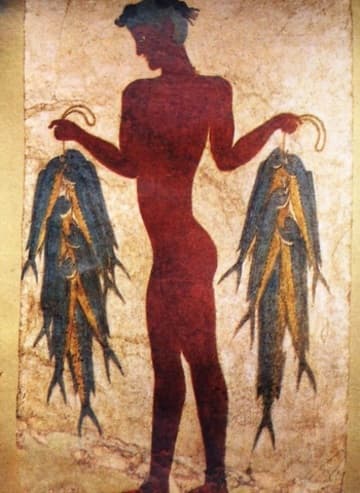
The impressive buildings of Akrotiri include three-story houses faced with masonry (some with balconies) and extensively decorated with frescoes, which were very well preserved in the ash. Most of them are displayed in the National Archaeological Museum in Athens; Santorini is trying to get them back. Meanwhile, a few frescoes are in the nearby Museum of Prehistoric Thira.
Visitors tour the Akrotiri site along ancient Akrotiri's main street, lined with stores and warehouses of the ancient commercial city. Many large earthen jars (pithoi) were found here, some with traces of olive oil, fish, and onion inside.
There are descriptive plaquesin four languages at various points along the path through the town, as well as small pictures of the famous frescoes next to the houses where they were found.
The best view of the town as a whole can be had from a triangular plaza near the exit, where the buildings rise to two stories. Also near the exit is the burial place of the site's chief archaeologist, Professor Syridon Marinatos of the University of Athens, who died in a fall at Akrotiri.
Highlights from Sacred Destinations
Highlights from Sacred Destinations
Advertisement
Advertisement
Advertisement
Where on earth