Highlights from Sacred Destinations
Explore the site
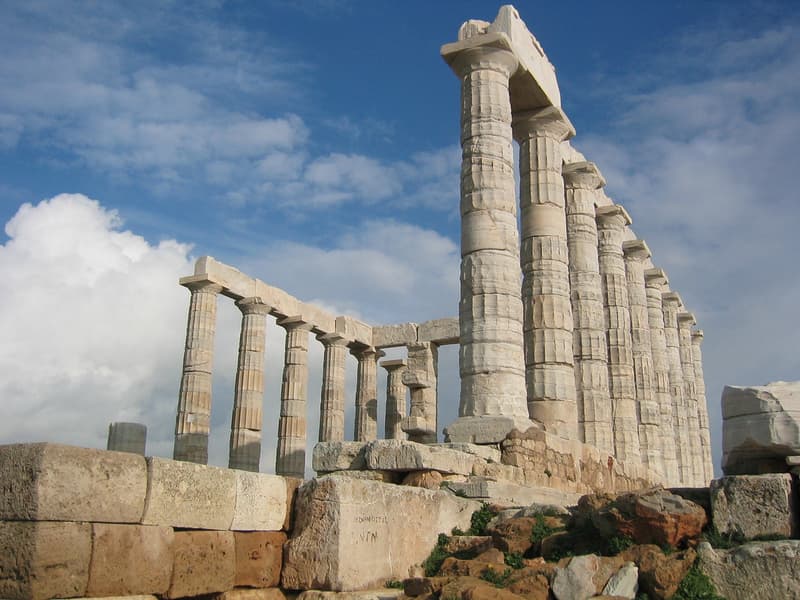
Local marble was used for the Temple of Poseidon's Doric columns ; 15 of the original 34 survive today.
/ Greece / Temple of Poseidon
Poseidon · 444 BCE
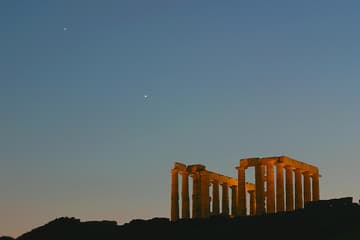
Overlooking the sea from atop the sheer cliffs of Cape Sounion, the Temple of Poseidon was built in 444 BC for the god of the sea.
The dramatic coastal location of Soúnio (Cape Sounion) in southern Attica was an ideal spot for a Temple of Poseidon, god of the sea. Standing atop sheer cliffs overlooking the Aegean Sea, the marble temple has served as a landmark for sailors from ancient times to today.
Soúnio has been a sacred site since very ancient times. The "sanctuary of Sounion" is first mentioned in the Odyssey, as the place where Menelaus stopped during his return from Troy to bury his helmsman, Phrontes Onetorides.
Archaeological evidence has shown that there were two organized places of worship on the cape by the 7th century BC: a sanctuary of Poseidon at the southern edge and a sanctuary of Athena about 500 m to the northeast.
Construction on a grand Temple of Poseidon began around 500 BC but was never completed; the temple and all the votive offerings were destroyed by the Persians in 480 BC. The Temple of Poseidon that now stands at Soúnio was built in 444 BC atop the older temple ruins. The Temple of Athena was also built at this time, atop her ancient sanctuary on the cape.
The sanctuaries began to decline from the 1st century BC onwards. Pausanias, who sailed along the coast around 150 AD, wrongly believed the prominent temple on the hill was the Temple of Athena.
Modern travellers visited Sounion long before excavations started on the site, including Lord Byron in 1810. Systematic excavations began on the site in 1897 and continue today.
Construction on a grand Temple of Poseidon began around 500 BC but was never completed; the temple and all the votive offerings were destroyed by the Persians in 480 BC.
Construction on a grand Temple of Poseidon began around 500 BC but was never completed; the temple and all the votive offerings were destroyed by the Persians in 480 BC.
Local marble was used for the Temple of Poseidon's Doric columns; 15 of the original 34 survive today. The columns were cut with only 16 flutings instead of the usual 20, which reduced the surface area exposed to the wind and sea water.
On the east side of the main path is an Ionic frieze made from 13 slabs of Parian marble. Badly eroded now, it depicted scenes from the battle of the Lapiths and centaurs and from the adventures of the hero Theseus (son of Poseidon in some legends).
The east pediment, on which only a seated female figure is preserved, probably once depicted the battle between Poseidon and Athena for the domination of Attica.
Lord Byron carved his name in the marble of one of the columns in 1810. He set an unfortunate precedent, as the temple is now covered in scrawled signatures and initials.
Highlights from Sacred Destinations
Highlights from Sacred Destinations
Advertisement
Advertisement
Advertisement
Where on earth