Highlights from Sacred Destinations
Explore the site
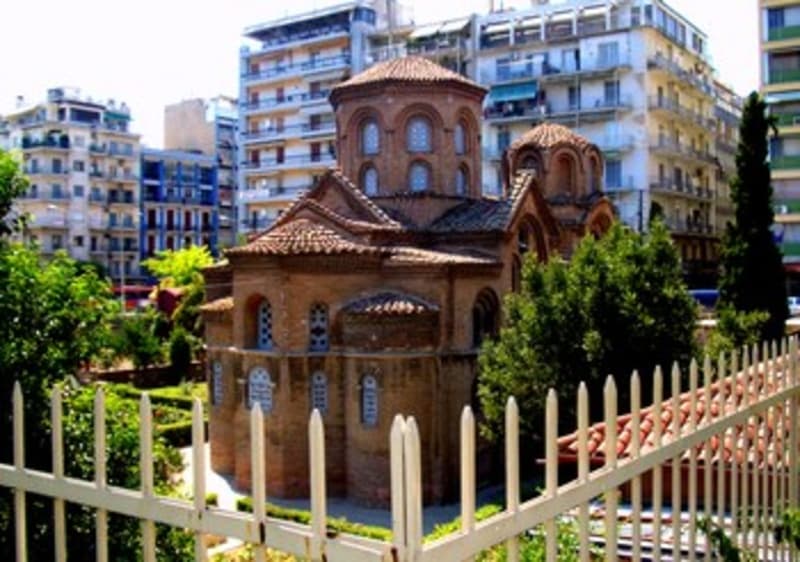
The Panagia Chalkeon has a classic Byzantine cross-in-square plan with three apses on the east end and a nathex on the west end.
/ Greece / Panagia Chalkeon
Virgin Mary · 1028
An 11th-century Byzantine church with an attractive facade and an extensive cycle of frescoes in the dome.
Located in a leafy garden, the peaceful Panagia Chalkeon Church (Virgin of the Copper Workers) in Thessaloniki dates from the 11th century and contains an almost complete cycle of frescoes.
The Panagia Chalkeon was founded in 1028 by Christophoros of Lombardy. Its unusual name comes from its use as a mosque for the copperworkers' guild (Kazançilar-Djami) during the Ottoman occupation, from 1430 to 1912. The church was restored in 1934.
The Panagia Chalkeon was founded in 1028 by Christophoros of Lombardy.
Its unusual name comes from its use as a mosque for the copperworkers' guild ( Kazançilar-Djami ) during the Ottoman occupation, from 1430 to 1912.
The Panagia Chalkeon has a classic Byzantine cross-in-square plan with three apses on the east end and a nathex on the west end. It is constructed of deep red bricks that have given it a local nickname of "Red Church." It has a rather charming appearance due to its small size and sunken position below modern street level.
The main facade is pleasingly symmetrical, with three tall arches and three domes. The central dome is supported on an octagonal drum and the cross-arms have triangular pediments.
Inside is a nearly complete cycle of 11th-century Byzantine frescoes, some of which seem to be inspired by the mosaics of the Agia Sophia. In the dome is the Ascension of Christ and the narthex depicts the Last Judgment.
Highlights from Sacred Destinations
Highlights from Sacred Destinations
Advertisement
Advertisement
Advertisement
Where on earth