Highlights from Sacred Destinations
Explore the site
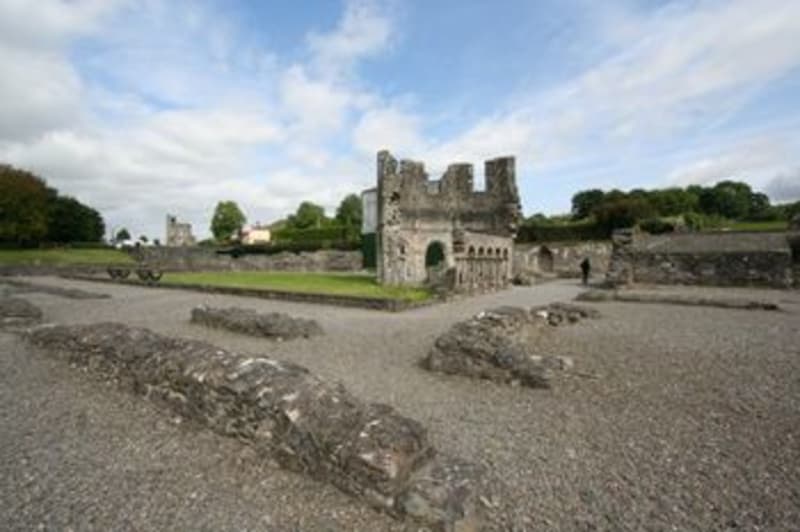
The first ruins visitors encounter are those of the abbey church , which has a typical cruciform plan and some gravestones in its floor.
/ Ireland / Mellifont Abbey
Virgin Mary · 1142
This Cistercian abbey is mostly in ruins, but there is a fine lavabo that is mostly intact, along with the chapter house and a section of the cloister. Nearby are ruins of a gateway and a small church.
Mellifont Abbey is a ruined 12th-century Cistercian monastery near Monasterboice in County Louth. It is of considerable historical significance, for it was the Cistercians' first and most important abbey in Ireland, and a site of conflict between the Irish and the Anglo-Normans.
Most of what remains of the great Mellifont Abbey is only foundations, but there is a fine lavabo that is mostly intact, along with the chapter house and a section of the cloister. There are also evocative ruins of a great gateway and a small church nearby.
By the mid-12th century, Irish monastic life (as in many other places) had become significantly less austere and more corrupt than in earlier days. So in 1140, Malachy, Bishop of Down, invited a group of severe Cistercian monks from Clairvaux to set up a monastery in Ireland and act as a reforming influence.
Malachy had stopped by Clairvaux in France during a pilgrimage to Rome and had been so impressed by St. Bernard (founder of the Cistercian order) and his monks that he converted to the monastic life himself. Malachy was canonized a saint after his death.
A group of Irish and French monks settled in this remote site in 1142 and began construction in the traditional Cistercian style. This marked the first time that a monastery was built in Ireland with the formal layout used in the Continent.
Within a couple decades, before Mellifont's church was even consecrated, nine more Cistercian monasteries were established in Ireland. At its height, Mellifont was the mother house of 21 monasteries and as many as 400 monks made Mellifont Abbey their home. In 1152, the abbey hosted the Synod of Drogheda.
By this time, all the monks of Mellifont were Irish, for an early dispute between the native Irish monks and the imported French monks led to the departure of the latter.
After the Dissolution of the Monasteries under King Henry VIII, Mellifont Abbey was demolished and sold. A fortified Tudor manor house was built on the site in 1556 by Edward Moore, using materials scavenged from the monastic buildings.
This house was the site of a turning point in Irish history. After Hugh O'Neill, last of the great Irish chieftains, was defeated in the Battle of Kinsale (1603), he was given shelter here by Sir Garret Moore. O'Neill soon surrendered to the English Lord Deputy Mountjoy and was pardoned, but he fled to the Continent in 1607 with other Irish leaders in the Flight of the Earls.
The site of Mellifont Abbey and its manor house was abandoned in 1727.
At its height, Mellifont was the mother house of 21 monasteries and as many as 400 monks made Mellifont Abbey their home.
So in 1140, Malachy , Bishop of Down, invited a group of severe Cistercian monks from Clairvaux to set up a monastery in Ireland and act as a reforming influence.
The first ruins visitors encounter are those of the abbey church, which has a typical cruciform plan and some gravestones in its floor. Beyond this, to the south, is the cloister (with only a short section of its colonnade remaining) and the chapter house.
The chapter house remains mostly intact and is partially paved with medieval glazed tiles that originally decorated the church. Adjacent to this was the refectory, kitchen and warming room. The monks' sleeping quarters was in the eastern range.
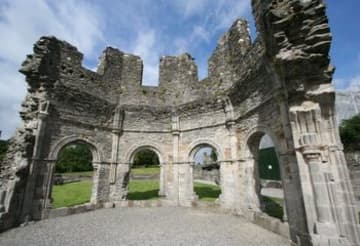
The most beautiful structure at Mellifont is the lavabo, an octagonal washing house. Built in the early 13th century, it used lead pipes to bring water from the river.
Up the hill from Mellifont Abbey and worth a quick look is a ruined little church, of unknown (to us) date but presumably used by the lay employees of the monastery.
Highlights from Sacred Destinations
Highlights from Sacred Destinations
Advertisement
Advertisement
Advertisement
Where on earth