Highlights from Sacred Destinations
Explore the site
Under the altar table is a block of limestone (1 x 0.
/ Israel / Church of the Loaves and Fishes
Sacred site · mosaics 5th C; church 1982
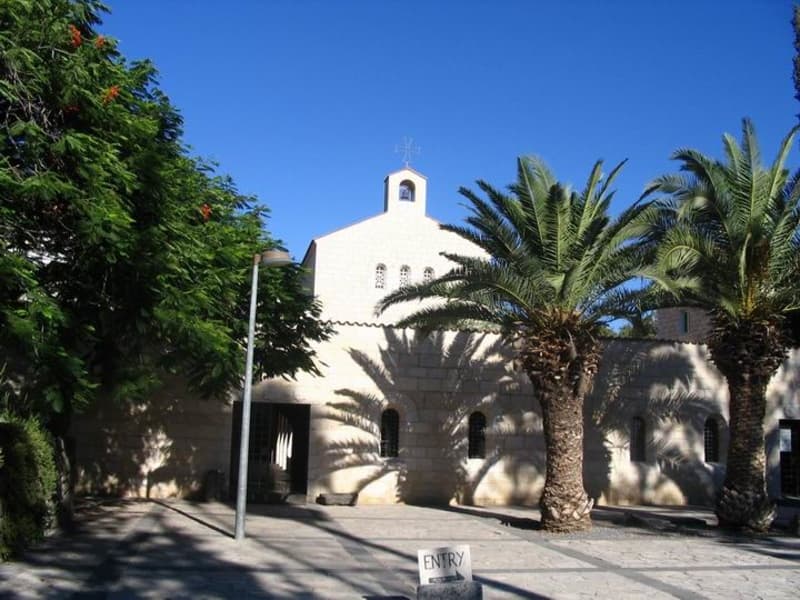
This church commemorates the Feeding of the Five Thousand and includes a portion of rock where the miraculous meal was laid. The Byzantine-style church preserves splendid 5th-century mosaics.
The Church of the Multiplication of the Loaves and Fishes (also known as the Church of the Multiplication) is a church in Tabgha (ancient Heptapegon) on the northwest shore of the Sea of Galilee.
The church is modern but stands on the site of 4th and 5th-century churches. It preserves a splendid early Christian mosaic as well as the traditional stone on which the miraculous meal was laid.
A church of the Feeding of the Five Thousand was first built on this site in c.350. The church was small (15.5m x 9.5m) and on a slightly different orientation than the later versions. The Spanish pilgrim Egeria visited this church in the 380s, and reported:
The church was significantly enlarged around 480 — an inscription attributes its building to the patriarch Matryrios (478-86) — which included the addition of the splendid floor mosaic. The mosaics were repaired in the 6th century and the church was destroyed around 685 AD.
The site was bought by the Deutsche Verien vom Heilige Lande and excavated in 1932; a protective cover was built over the mosaics in 1936. In 1982 this was replaced by the modern Church of the Multiplication of the Loaves and Fishes that stands today, which is a faithful reconstruction of the original.
350.
The Spanish pilgrim Egeria visited this church in the 380s, and reported: The church was significantly enlarged around 480 — an inscription attributes its building to the patriarch Matryrios (478-86) — which included the addition of the splendid floor mosaic.
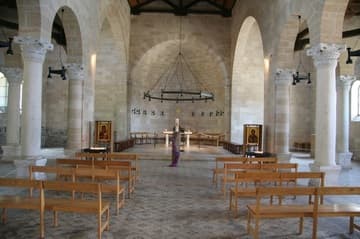
Under the altar table is a block of limestone (1 x 0.6 x 0.14m) venerated as the table of the Lord. This is unlikely to be the same one Egeria saw in the 4th century (see History, above), and of course pilgrims are no longer permitted to chip away at it! In front of the altar is a lovely restored mosaic of two fish flanking a basket of loaves.
Besides its sacred importance as the place of a miracle of Jesus, the main highlight of the Church of the Loaves and Fishes is this beautiful 5th-century figurative mosaic floor. It is the earliest known example of a figured pavement in Palestinian Christian art.
The main mosaic covers the two transepts and the intervals between the pillars (the rest of the floor has a mosaic in a simple geometric pattern, mostly restored). The principal mosaic was clearly designed by a great master who was able to create a free-flowing design without need of any repetitious pattern.
The mosaic depicts birds and plants, with a prominent place given to the bell-like lotus flower. This flower is not found in the area and indicates the influence of the Nilotic landscapes then popular in Hellenistic and Roman art.
However, all the other motifs depict flora and fauna from Galilee - the level of detail allows the identification of each species. There are charming "ducks in love" in the lower center and a depiction in the upper left of the round tower (nilometer) that was used to measure water level. Also visible are the Greek letters for the numbers 6 to 10.
A few other parts of the 5th-century Byzantine church are preserved in the modern church, including the sill of the left entrance to the atrium, some of the basalt paving stones of the atrium, and part of the frieze in the apse. The foundations of the original 4th-century church can be seen under a glass panel. Old basalt presses and a font are displayed in the courtyard.
Highlights from Sacred Destinations
Highlights from Sacred Destinations
Advertisement
Advertisement
Advertisement
Where on earth