Highlights from Sacred Destinations
Explore the site
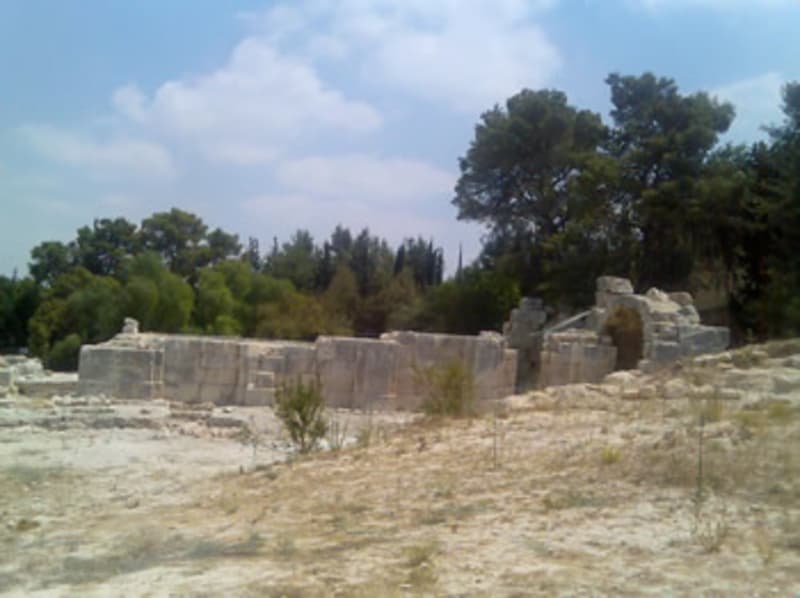
Emmaus Nikopolis is home to a 4th or 5th century Byzantine basilica that was substantially rebuilt by the Crusaders .
/ State of Palestine / Emmaus Nicopolis
Sacred site
Located about 30km west of Jerusalem, a Crusader church marks the traditional site where Jesus was not recognized by two disciples after the Resurrection.
Emmaus is the village in which Jesus first appeared after the Resurrection. It is described as being not far from Jerusalem, but its identification with any particular location is not certain.
This particular village, which was the ancient city of Nikopolis, was identified as the biblical Emmaus since the fourth century or earlier, and it became an important pilgrimage destination throughout the Byzantine era and Middle Ages. However, modern scholars think this site is highly unlikely to be the biblical Emmaus, mainly because it is too far from Jerusalem.
Today Emmaus Nikopolis is a Muslim village with excavated ruins of a Byzantine basilica with Crusader renovations, a small archaeological museum, and a modern Trappist monastery.
A little after the victory of the Maccabees mentioned above, the Syrian general Bacchides fortified and garrisoned Emmaus (Josephus, Ant. Jud. 13.1.3). In 4 AD, during the rebellion of Athrongius against the Romans, the inhabitants of Emmaus left their city, but it was nevertheless destroyed by Varus (Josephus, Ant. Jud. 17.10.7-9). The city recovered soon after, though, and Josephus (Bel. Jud. 3.3.5) and Pliny (Hist. nat., 5.14) rank it amongst the "toparchies" of the country.
Emperor Vespasian took Emmaus at the beginning of his campaign against the Jews, stationed a legion in the neighbourhood, and named it Nikopolis (according to Sozomon, Hist. eccl. 5.21). According to Eusebius and St. Jerome, the city was named Nikopolis in 223 by Julius Africanus, its governor and most illustrious son.
The pagan emperor Julian the Apostate closed a sacred spring at Emmaus Nikopolis in which Christ was said to have washed his feet and which was believed to have healing properties (Sozomon, Hist. eccl., 5.21). The city had a bishop, who was subject to the Bishop of Jerusalem, throughout the Byzantine era.
At the beginning of the Arab conquest the plague broke out in Emmaus and the inhabitants fled. But they must have soon returned, for Emmaus remained a very important town. It was the last station captured by the Crusaders on their way to Jerusalem on June 6, 1099. In the later Middle Ages Emmaus seems to have had some Latin bishops.
The ancient site was excavated between 1924 and 1930, but much remains to be uncovered. Today, Emmaus Nikopolis is known as 'Am'was and is a Muslim village.
In 4 AD, during the rebellion of Athrongius against the Romans, the inhabitants of Emmaus left their city, but it was nevertheless destroyed by Varus (Josephus, Ant.
Jerome, the city was named Nikopolis in 223 by Julius Africanus, its governor and most illustrious son.
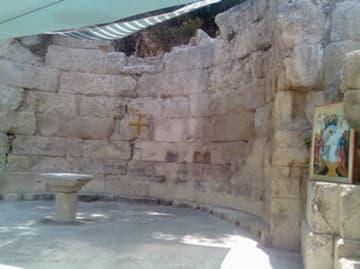
Emmaus Nikopolis is home to a 4th or 5th century Byzantine basilica that was substantially rebuilt by the Crusaders. Its apse and walls remain standing and there is a simple stone altar in the apse. One artifact can be seen at the church, which is a replica of an interesting Byzantine inscription found here. It reads, "In the name of the Father, the Son and the Holy Spirit. Beautiful, the city of the Christians is."
Also at the site is a small museum that displays Jewish ossuaries and ancient mosaics. More remains of the ancient city of Emmaus can be seen in Ayalon Park, a few hundred meters past the entrance.
Just south of the highway from the Emmaus site is the Latrun Monastery (a.k.a. El-Atroun), founded by the Trappists in 1890. The Trappists are a strict sect of Cistercian monks, who keep silent most of the time. The priory is thus also known as the Monastery of Silence.
Highlights from Sacred Destinations
Highlights from Sacred Destinations
Advertisement
Advertisement
Advertisement
Where on earth