Highlights from Sacred Destinations
Explore the site
Ring a bell for admission if the door is not open.
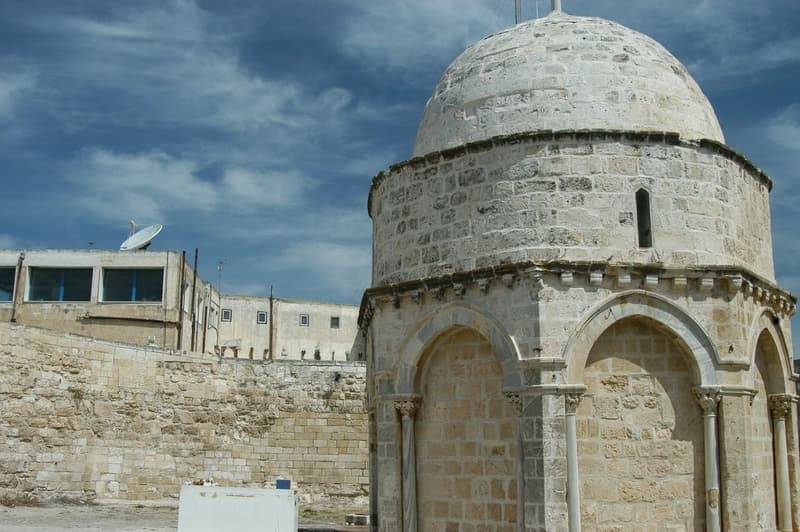
/ Jerusalem / Chapel of the Ascension
Sacred site · 390; rebuilt 1150
Both a Christian and Muslim holy site, this Crusader-era chapel marks the spot where Jesus ascended into heaven after his resurrection. His footprint is imprinted in the floor.
The Chapel of the Ascension in Jerusalem is a Christian and Muslim holy site that is believed to mark the place where Jesus ascended into heaven. The small round church/mosque contains a stone imprinted with the very footprints of Jesus.
Before the conversion of Constantine (312), early Christians honored the Ascension of Christ in a cave on the Mount of Olives, probably because of concerns for safety. By the time the pilgrim Egeria visited Jerusalem in 384, the place of the Ascension was venerated on the present open site, uphill from the cave.
The first church was built here around 390 by Poimenia, a pious Roman lady. The original church was destroyed in the Persian attack of 614 but restored by Modestus.
In 680, the pilgrim Arculf described the church as a round building open to the sky, with three porticoes entered from the south. Eight lamps shone brightly at night through windows facing Jerusalem. Inside was a central edicule containing the footprints of Christ "plainly and clearly impressed in the dust" inside a railing. Pilgrims were permitted to take some of the dust home with them!
A 9th-century record notes that the church was served by three clergy and presbyters. When the Crusaders arrived, they rebuilt the Church of the Ascension as a roofed octagon (c.1150) and fortified the exterior.
In 1198, after the fall of the Crusader kingdom, Salah al-Din gave the church to two of his followers, who added a stone dome and mihrab. The ascension of Jesus is recognized in Islam, although it is not mentioned in the Qur'an. The building remained in use as a mosque for over 300 years.
The building fell into ruin by the end of the 15th century, and the east section of the octagonal surround-wall was walled off to form the asymmetrical shrine that stands today. A mosque and minaret were added next to the chapel in 1620 and the entire site remains in Muslim possession.
The building remained in use as a mosque for over 300 years.
Before the conversion of Constantine (312), early Christians honored the Ascension of Christ in a cave on the Mount of Olives, probably because of concerns for safety.
Ring a bell for admission if the door is not open. To the right of the entrance is the small 1620 mosque, Zawiyat al-Adawiyya, from which there is a good view of the Chapel of the Ascension and the surrounding countryside.
The entrance leads into a courtyard with a paved path leading to the small Chapel of the Ascension. The main body of the chapel is from the Crusader era; the octagonal drum and stone dome are Muslim additions.
The exterior octagonal walls are decorated with arches and slim marble columns, which support fine 12th-century capitals. These feature entwined foliage, two with animal motifs featuring winged quadrapeds with the heads of birds.
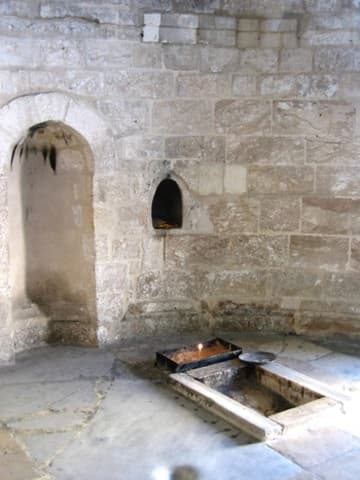
Entered from the west, the chapel has a mihrab indicating the direction of Mecca in the south wall. On the floor, inside an asymmetrically placed frame, is a slab of stone imprinted with the right footprint of Christ. The section bearing the left footpring was taken to the Al-Aqsa Mosque in the Middle Ages.
Hooks in the wall around the courtyard are used to stretch tents for the celebration of the Feast of the Ascension, which draws many pilgrims.
A small burial crypt next to the chapel is revered by all three monotheistic religions, but based on different beliefs about its occupant. Jews believe it contains the 7th-century BC prophet Huldah, one of seven female prophets mentioned in the Bible (2 Kings 22:14-20); Christians hold it to be the tomb of the 5th-century saint Pelagia; while Muslims maintain that the 8th-century holy woman Rabi'a al-Adawiya (for which the mosque is named) is buried here.
Highlights from Sacred Destinations
Highlights from Sacred Destinations
Advertisement
Advertisement
Advertisement
Where on earth