Highlights from Sacred Destinations
Explore the site
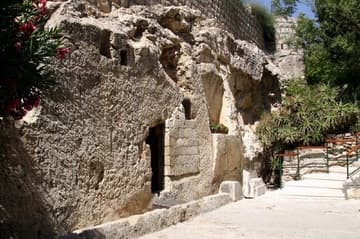
At "Gordon's Calvary," the shape of a skull , at least large eye sockets, can be discerned in the cliffside.
/ Jerusalem / Garden Tomb
Sacred site · 9C-7C BCE
Discovered in 1867, this ancient tomb in a peaceful garden is honored by many Protestants as the site of Jesus' burial instead of the Church of the Holy Sepulchre in the Old City.
The Garden Tomb is an alternative to the Church of the Holy Sepulchre as the actual site of Jesus' burial in Jerusalem. It was discovered in 1867 and is especially popular with Protestants as a place of devotion.
In the 19th century, a number of scholars disputed the identification of the Church of the Holy Sepulchre with the actual site of Jesus's crucifixion and burial. In 1842, Otto Thenius proposed that a rocky outcrop outside the walls was Calvary (Golgotha), the place of the skull.
The Garden Tomb itself was discovered in 1867, and was soon identified as the burial place of Jesus, mainly because of its location in the area that had been identified as Calvary. Another factor in its favor was the recent discovery the tombstone of the deacon Nonnus in the nearby Church of St. Stephen, which mentioned the Holy Sepulchre.
The Anglican Church committed itself to the site as the place of Jesus' burial and "Gordon's Tomb" became the "Garden Tomb." The Church has since withdrawn its formal support, but the Garden Tomb continues to be identified by popular Protestant piety.
In 1842 , Otto Thenius proposed that a rocky outcrop outside the walls was Calvary (Golgotha), the place of the skull.
The Garden Tomb itself was discovered in 1867 , and was soon identified as the burial place of Jesus, mainly because of its location in the area that had been identified as Calvary.
At "Gordon's Calvary," the shape of a skull, at least large eye sockets, can be discerned in the cliffside. This rocky escarpment was used as a rock quarry, perhaps druing the time of Herod Agrippa I (37-44 AD).
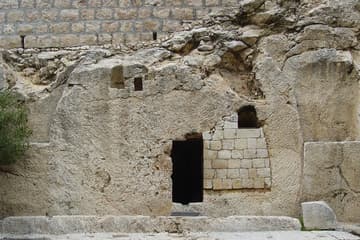
The garden tomb itself is located about 100 yards west of the "skull." The tomb is marked by multilingual signs and a wooden door bearing the English words, "He is not here - for he is risen."
The door and windows in the tomb facade probably date from Byzantine or Crusader times. The deep channel along the ground, sometimes identified as the groove for the rolling stone used to seal the tomb, is of unknown date and purpose.
Inside the tomb there are two chambers side by side. From the vestibule, one turns right to enter the burial chamber. This configuration is typical of 9th-7th century (Iron Age) tombs in the area. Tombs from the time of Jesus have the burial chamber behind the vestibule in a straight line, and each body bench (arcosolium) set within an arch. In the Garden Tomb, the body benches simply extend from the wall.
As mentioned above, the body benches were carved down by Byzantine Christians to use as rock sarcophagi; this can still be seen. In the Middle Ages, the Crusaders lowered the rock surface in front of the tomb, built vaults against it, and used the site as stable.
The Garden Tomb is a quiet place intended for worship and reflection. There are good facilities, including benches, drinking water , toilets, and wheelchair access to the garden. There is also a well-stocked gift shop.
Highlights from Sacred Destinations
Highlights from Sacred Destinations
Advertisement
Advertisement
Advertisement
Where on earth