Highlights from Sacred Destinations
Explore the site
Mount Tabor can be seen from miles around and there are fine views across the Jezreel Valley from the top, demonstrating its strategic importance.
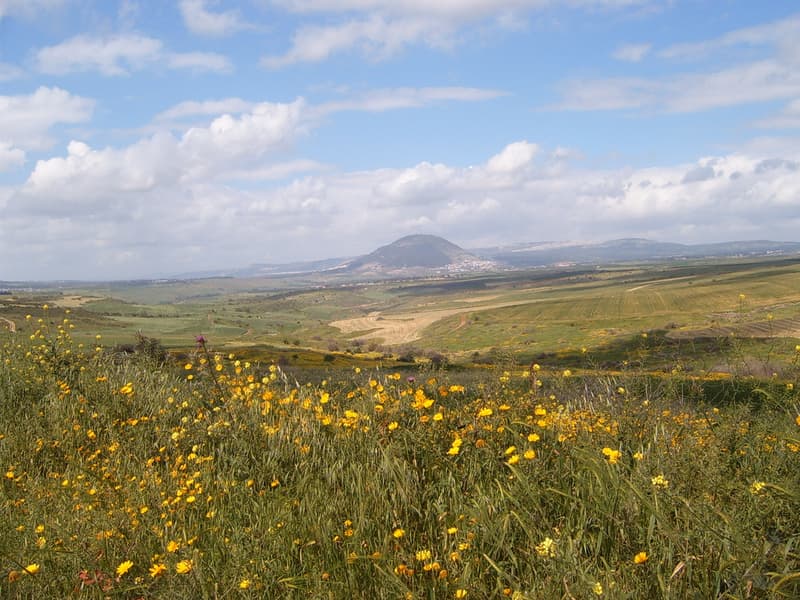
/ Israel / Mount Tabor
Sacred site
This steep hill has played an important role as a fortress in biblical and Greco-Roman times and it is thought by some to be the site of the Transfiguration.
Mount Tabor (Hebrew: Har Tavor) is a hill rising 500m above the Jezreel Valley in the region of Galilee. Due to its strategic location along the north-south road, it has been an important fortress since ancient times. Christians have identified a rock atop Mt. Tabor as the place of the Transfiguration of Christ since the 4th century AD.
Due to its strategic importance, Mount Tabor has often been surmounted by a fortress. Tabor was first occupied by a Seleucid fortress in the 3rd century BC. It was later refortified in 66 AD by Josephus during the First Jewish Revolt, but fell to Roman Emperor Vespasian in 67.
In 348, Bishop Cyril of Jerusalem wrote that he preferred Mt. Tabor to Mt. Hermon as the site of the Transfiguration, and by the end of the 4th century there was a church on the site. By 570, three Byzantine churches are recorded as standing on Mt. Tabor, or perhaps one large church with chapels dedicated to Christ, Moses and Elijah.
By the 7th century, there was a fortifed Monastery of the Transfiguration associated with Armenian monks atop Mt. Tabor. A Greek bishop is mentioned in the 9th century.
Mount Tabor was an important sacred site in the Crusader period, and many hermits lived in cells on the mountain slopes. A Latin abbot was appointed to the monastery soon after 1099 and the Greek Orthodox monastery was put to us as a Benedictine house under a bishop in 1103-28. The three Byzantine churches or chapels were still standing at this time.
Islamic forces raided the monastery in 1113, but it was re-established by 1115. At some point in the 12th century, the old Byzantine triple church was replaced with a Romanesque basilica with three aisles, six bays and three apses. It enclosed the sacred rock that was believed to be the very site of the Transfiguration. Stretching north and south of the church were the extensive buildings of a Benedictine monastery, including a chapel and a small bath house.
In 1183, part of Salah al-Din's army climbed Mount Tabor and sacked the Greek monastery, but failed to take the larger fortified Latin monastery until 1187. B
eginning in 1212, Ayyubid leaders al-Adil and later al-Mu'azzam Isa built massive walls and fortifications across the entire high plateau of Mount Tabor in order to guard the road to Acre. The wall was defended by 13 towers and a rock-cut ditch. But after a nearly-successful Crusader attack in 1217, al-Mu'azzam demolished the fortifications.
Throughout this period, the Basilica of the Transfiguration seems to have survived intact and pilgrims continued to visit it. Mount Tabor was back in Frankish hands from 1229 to 1241. In 1255, it was granted to the Hospitallers, but in 1263, Baybars destroyed the church and the mountain became a royal hunting park for the Mamluks.
In the 14th century, local Christians are recorded as decking the ruined churches atop Mount Tabor with flags at the Feast of the Transfiguration (August 6), a custom that continued for many centuries.
In 1631, Fakhr al-Din granted the Franciscans permission to live atop Mount Tabor, and this permission was confirmed by the Ottoman government on various occasions in the 17th and 18th centuries. The Franciscans mainly used rooms of the ruined castle bath house until they rediscovered the ruined Crusader church in 1858 and began reconstruction. In 1924, the present church, which stands over the 12th century church, was completed.
It was later refortified in 66 AD by Josephus during the First Jewish Revolt, but fell to Roman Emperor Vespasian in 67.
In 348 , Bishop Cyril of Jerusalem wrote that he preferred Mt.
Mount Tabor can be seen from miles around and there are fine views across the Jezreel Valley from the top, demonstrating its strategic importance. The 13th-century walls can still be seen around the summit, which is divided into Greek Orthodox (northeast) and Latin Catholic (southeast) areas. On the west side are ruins of Josephus' fortifications. The Latin section is reached through the Gate of the Winds, which was al-Adil's main fortress gate.
The Latin (Franciscan) Church of the Transfiguration (or Church of the Savior) dates from 1924 but stands on the same site and reflects the plan of the earlier Crusader and Byzantine churches.
In the crypt, the west door is now blocked by the new entrance and the lowered floor of the nave. The chapel south of the west entrance had a 12th-century wall tomb and a mosaic floor, which was relaid in 1924.
About 20m west of the church, on the north side of the entrance path, is a small ruined chapel that may have been the private chapel of the abbot in the 12th century. The entrance is in the west end of the south wall, a bench lines the walls and the base of a chancel screen can be seen. Two steps lead up to the sanctuary where a projection on the upper step marks the original location of the altar (the present altar is modern). The apse has remains of a window and two aumbries.
In the Greek area is the Church of St. Elias, built in 1845. It is a three-aisled basilica with four bays and the lower part of its apses may be early 12th century. The wall paintings were added in 1912.
Representing the ascetic hermit tradition on Mount Tabor is the Church of St. Melchizedek, located on the northwest side of the upper plateau. The name derives from a 4th-century tradition in which Melchizedek spent seven years as a hermit on Mount Tabor before meeting and blessing Abraham. Most of the present church dates fromthe 19th century, but reuses older masonry.
Highlights from Sacred Destinations
Highlights from Sacred Destinations
Advertisement
Advertisement
Advertisement
Where on earth