/ Italy / Marienberg Abbey
Virgin Mary · 1150; rebuilt after 1418
Marienberg Abbey
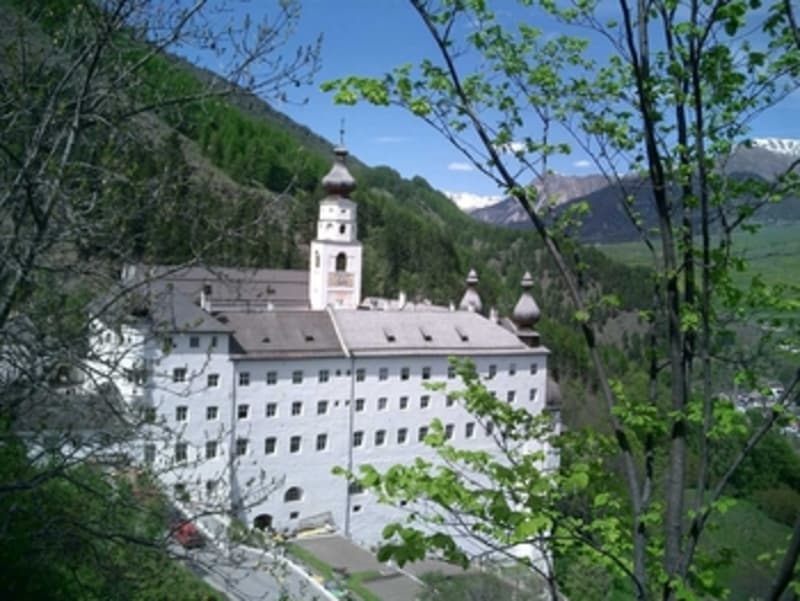
The highest abbey in the world (4,400 feet), the Benedictine monastery of Marienberg was founded in 1150.
Marienberg Abbey (Abbazia Monte Maria; Kloster Marienberg) is a Benedictine abbey founded in 1150 with a long tradition of education. Located in far north of Italy in the South Tyrol region, Marienberg is Europe’s highest abbey at 1,340 m (4,400 ft). It is built in a Baroque style with some Romanesque elements, and has some well-preserved frescoes.
History
The history of Marienberg Abbey goes back to Charlemagne, who established in 780-86 a Benedictine monastery near Taufers in Graubünden. This was dissolved after 880 and replaced by a convent for both sexes. Two hundred years later there was a reorganization: for the monks, Eberhard of Tarasp built the monastery of Schuls in the Engadine (consecrated by Cardinal Gregor in 1078 or 1079), while the nuns remained at Taufers (later called Münster).
Destroyed by lightning, Schuls was rebuilt and consecrated in 1131. Ulrich IV of Tarasp shortly after called monks from Ottobeuern to Schuls to instill new life into the monastery. At the same time the monastery, which till then had been merely a priory, was made an abbey. In 1146 he removed the community to St. Stephen in Vintschgau, and in 1150 to the hill near the village of Burgeis, where the abbey has since continued under the name of Marienberg. Ulrich himself later assumed the habit of the order (about 1164) in Marienberg, and died on 14 December, 1177.
Under Abbot Konrad III (1271-98) Marienberg was sacked by two nobles, and in 1304 Abbot Hermann was killed by Ulrich of Matsch. In 1348 the plague carried away every inhabitant of the monastery except Abbot Wyho, a priest, one lay brother, and Goswin, later a chronicler. Goswin became a priest in 1349, and compiled new choir-books, two estate registers (Urbare), and the chronicle of the monastery (finished 1374).
Under Abbot Nicholas (1362-88) Goswin became prior, while in 1374 he was appointed court chaplain to Duke Leopold III of Austria. In 1418 Marienberg was burned down. After a period of decline in the 16th century, Abbot Mathias Lang (1615-40), from Weingarten monastery, became the reformer of the abbey. In 1634 Marienberg joined the Benedictine Congregation of Swabia. Lang's successor, Jacob Grafinger (1640-53), enlarged the library, and made the younger members finish their education at schools of repute.
In 1656 the abbey was again burned down. Abbot Johann Baptist Murr (1705-32) founded in 1724 the gymnasium at Meran, still administered by the monks of Marienberg. Abbot Pacidus Zobel (1782-1815) compiled a chronicle of the abbots. In 1807 Marienberg was dissolved by the Bavarian government, but was again restored by Emperor Francis II in 1816.
Today, seven fathers and four brothers live in Marienberg abbey under the Benedictine Rule. The abbey is open to visitors and hosts weekend courses and retreats.
The history of Marienberg Abbey goes back to Charlemagne, who established in 780-86 a Benedictine monastery near Taufers in Graubünden.
This was dissolved after 880 and replaced by a convent for both sexes.
Advertisement
Advertisement
Advertisement
Gallery
Location
Where on earth