Highlights from Sacred Destinations
Explore the site
Milan's Duomo is the second largest Catholic cathedral in the world: only Seville Cathedral is larger (and St.
/ Italy / Milan Cathedral
Virgin Mary · 1616-c.1880
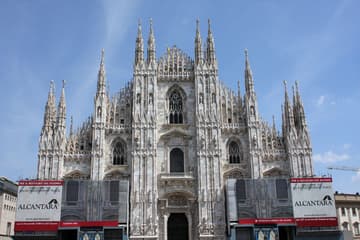
Milan Cathedral is a elaborate and spiky Gothic edifice on the main square in the city center. It is the second largest Catholic cathedral in the world. And you can walk on the roof!
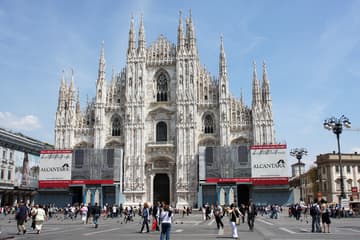
An exceptionally large and elaborate Gothic cathedral on the main square of Milan, the Duomo di Milano is one of the most famous buildings in Europe. It is the largest Gothic cathedral and the second largest Catholic cathedral in the world.
The street plan of Milan, with streets either radiating from the Duomo or circling it, indicates that the Duomo occupied the most important site in the ancient Roman city of Mediolanum.
Saint Ambrose built a new basilica on this site at the beginning of the 5th century, with an adjoining basilica added in 836. When fire damaged both buildings in 1075, they were rebuilt as the Duomo.
In 1386 the archbishop, Antonio da Saluzzo, began the new project in a rayonnant Late Gothic style that is more characteristic of France than Italy. Work proceeded for generations.
The main spire was topped in 1762 with a polychrome statue of the Madonna, to whom the Duomo and its predecessor have always been dedicated.
Even now, some uncarved blocks remain to be turned into sculpture. Gothic construction on the rest of the Duomo was largely complete in the 1880s.
The Duomo was recently under major renovations and cleaning for several years, obscuring the west front with scaffolding. Works were finally completed in 2009, revealing the newly-cleaned facade in all its glory.
Saint Ambrose built a new basilica on this site at the beginning of the 5th century , with an adjoining basilica added in 836.
When fire damaged both buildings in 1075, they were rebuilt as the Duomo.
Milan's Duomo is the second largest Catholic cathedral in the world: only Seville Cathedral is larger (and St. Peter's Basilica doesn't count because it's not a cathedral). Milan Cathedral is 157 meters long and 40,000 people can fit comfortably within.
The Duomo of Milan blurs the distinction between Gothic and neo-Gothic, for the Gothic west front was begun in 1616 and completed 200 years later. Only in its details does it reveal its Baroque and Neo-Classical date. From 1900 some of the less Gothic details of the facade were replaced in a true Gothic style, to designs of Giuseppe Brentano.
The roofline dissolves into openwork pinnacles that are punctuated by a grove of spires, topped with statues that overlook the city. The main spire is 109 meters high. These can all be investigated up close on a breathtaking walk on the roof.
The huge building is made of brick faced with marble from the quarries that Gian Galeazzo Visconti donated in perpetuity to the cathedral chapter.
The cathedral's five wide naves are reflected in the hierarchic openings of the facade. Even the transepts have aisles. The great windows of the choir are reputed to be the largest in the world.
Mark Twain, a great fan of the Duomo, can take over the description from here (from Innocents Abroad):
We don't think the Duomo di Milano is quite as exciting as Mark Twain did. Although the facade is lovely and the cathedral is impressively large, it is quite dark and not terribly interesting inside.
However, all the extras of the Duomo are very interesting: the roof climb; the treasury; and the excavations of the Early Christian baptistery.
The roof climb provides a unique and memorable opportunity to walk high on the roofs of the huge Gothic cathedral. The views are magnificent and the opportunity to see the pinnacles and sculptures close up along the way is worth the climb alone.
Entrance is from the north side of the cathedral (walk around left from the front). You can choose to walk up the stairs - which are solid, square, and more roomy than many cathedral stairways - or take an elevator for a higher price.
The crypt is entered from inside the cathedral near the choir. Entrance to the crypt is free and many visitors descend the short stairway to visit the tomb of Cardinal Borromeo.
Also in the crypt is the Tesoro del Duomo, or Cathedral Treasury. If you have any interest in medieval art, religious art, or "old stuff" in general, this is a must-see. And admission is only €1. Please see our separate article and photo gallery of the Cathedral Treasury for more details.
Archaeological excavations beneath the cathedral have revealed the foundations of a Paleochristian Baptistery dating from the 4th century. It is said to be the baptistery in which St. Ambrose, Bishop of Milan, baptized his student Augustine. Please see our separate article on the Paleochristian Baptistery for more details.
Highlights from Sacred Destinations
Highlights from Sacred Destinations
Advertisement
Advertisement
Advertisement
Where on earth