Highlights from Sacred Destinations
Explore the site
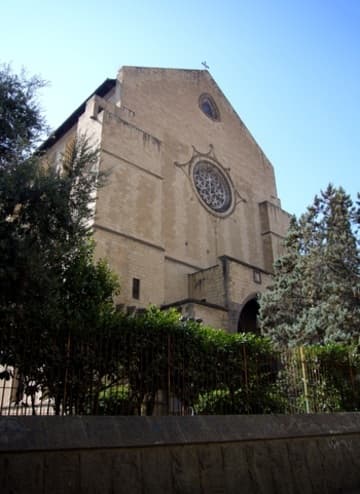
The west facade of Santa Chiara is austere, with only a central rose window for decoration.

/ Italy / Santa Chiara
St. Clare of Assisi · 1310-28
One of the largest and most important churches in Naples, Santa Chiara was founded in 1310 as a Franciscan convent. The site includes beautiful cloisters and a museum.
Santa Chiara is one of the largest and most important churches in Naples. Founded in 1310 by Robert the Wise, the basilica is part of a large Franciscan complex that also includes beautiful cloisters and a museum.
Santa Chiara was founded in 1310 by Robert the Wise (a.k.a. Robert of Anjou and Robert of Naples) for his second wife, Queen Sancha, who became a nun here. The basilica and convent were designed in an austere Provencal-Gothic style and completed in 1328.
The ill-fated Joan I of Anjou, granddaughter of Robert the Wise, was crowned queen in Santa Chiara in 1343 and buried here after her murder in 1382.
The church interior was given a Baroque makeover in 1742-57, which was sadly destroyed by an Allied bomb in August 1943. Santa Chiara was rebuilt in 1953 in its original style.
Santa Chiara was founded in 1310 by Robert the Wise (a.
The basilica and convent were designed in an austere Provencal-Gothic style and completed in 1328.
The west facade of Santa Chiara is austere, with only a central rose window for decoration. The west porch is original from the early 14th century; it was not damaged by the Allied bomb. The lower part of the campanile dates from the 14th century, but it was not completed until 1647.
The interior, which is the largest in Naples, has no side aisles to break up the space. Modern stained glass fills the lancet windows. Ten chapels open on to the nave, all containing notable Gothic monuments.
There are several notable Angevin tombs in the church, among which the most important are those of:
Joan I (d. 1382) is also buried here, but she was denied a Christian burial for schismatic activities and occupies an unmarked ossuary under the church floor.
The cloister of Santa Chiara is reached through a courtyard on the north side of the church, near the campanile. Dating originally from the 14th century, the large cloister was transformed into an elegant garden by Domenico Antonio Vaccaro in 1742. The beautiful majolica tiles and terracottas date from this period. Surviving from the Middle Ages is the austere friar's refectory, with a fountain in the middle.
The cloister includes a museum (Museo dell'Opera di Santa Chiara), with displays illustrating the history of the convent.
Highlights from Sacred Destinations
Highlights from Sacred Destinations
Advertisement
Advertisement
Advertisement
Where on earth