Highlights from Sacred Destinations
Explore the site
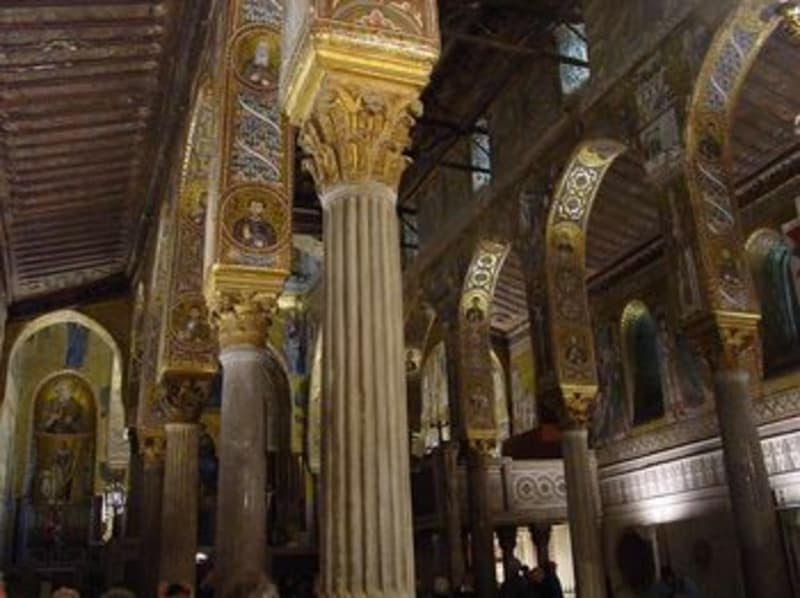
The Palatine Chapel is comprised of a nave and two aisles divided by tall oval arches (whose pillars are made of granite shipped from the East) and covered with a cupola.
/ Italy / Cappella Palatina
Sacred site · 1140
Located within the Norman Palace, the Palatine Chapel is the finest example of Arab-Norman art in Palermo. Built by Roger II from 1130 to 1140, it is adorned with extraordinary Byzantine mosaics.
Located within the Palazzo dei Normanni (Palace of the Normans), the Cappella Palatina (Palatine Chapel) is the finest example of Arab-Norman art in Palermo. Built by Roger II from 1130 to 1140, the chapel is adorned with extraordinary Norman-Byzantine mosaics. Together the palace and its chapel are the greatest attractions of Palermo and the only must-see sight for visitors with limited time.
The palace was originally built for the Arab emirs and their harems in the 9th century, on a site earlier occupied by Roman and Punic fortresses.
Eventually abandoned by the Arabs, the palace was fully restored by the conquering Normans. The Palatine Chapel was completed by the Norman king Roger II in 1140.
After the Normans left, the palace fell into serious decay until it was discovered by Spanish viceroys. In 1555, they began to restore it and it became a royal residence once again. Today, the Palazzo dei Normanni is the seat of Sicily's semi-autonomous regional government.
The Palatine Chapel was completed by the Norman king Roger II in 1140.
In 1555, they began to restore it and it became a royal residence once again.
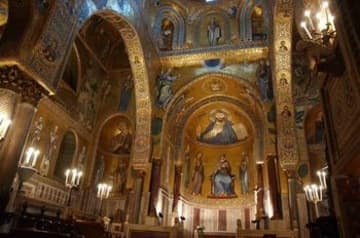
The Palatine Chapel is comprised of a nave and two aisles divided by tall oval arches (whose pillars are made of granite shipped from the East) and covered with a cupola. The astonishing interior is completely covered in glittering 12th-century mosaics.
The mosaics depict a variety of saints and biblical scenes, some interpreted in unique ways - Adam and Eve are shown with the forbidden fruit in their mouths, already reaching for a second piece. Christ Pantocrator is the central focus, appearing in the apse and the cupola.
The colors of the mosaics have an extraordinary depth and vividness (the effect sometimes achieved by gold-backed tesserae and silver mosaic tiles) and the subjects have a realistic style. The overall effect recalls that of the magnificent Monreale Duomo.
The mosaiced interior is capped by a splendid 10th-century Arab honeycomb stalactite wooden ceiling, painted with biblical stories as well as scenes of Arab and Norman court life - including animal hunts, dances and even a picnic in a harem.
Among notable furnishings are a huge royal throne covered in mosaics near the entrance to the nave, and a 12th-century Paschal candelabrum carved with figures, wild animals, and acanthus leaves.
Highlights from Sacred Destinations
Highlights from Sacred Destinations
Advertisement
Advertisement
Advertisement
Where on earth