Highlights from Sacred Destinations
Explore the site
Italy's largest baptistery (54.
/ Italy / Pisa Baptistery
St. John the Baptist · 1153; 1300s
Begun in 1153 in a Romanesque style and completed in the 1300s in the Gothic style, the Battistero di San Giovanni is the largest in Italy. Among its notable furnishings are a large central font and a Pisano pulpit.
Begun in 1153 in a Romanesque style and completed in the 1300s in the Gothic style, the Baptistery (Battistero di San Giovanni) in Pisa is the largest in Italy. It contains some important furnishings, including a font and Pisano pulpit.
Construction on the baptistery began in the Romanesque style under Diotisalvi in 1153. Nicola and Giovanni Pisano gave the upper part a Gothic transformation between 1277 and 1297 and Cellino di Nese added the Gothic dome in the 1300s. It was finally completed in 1363.
Construction on the baptistery began in the Romanesque style under Diotisalvi in 1153 .
Nicola and Giovanni Pisano gave the upper part a Gothic transformation between 1277 and 1297 and Cellino di Nese added the Gothic dome in the 1300s.
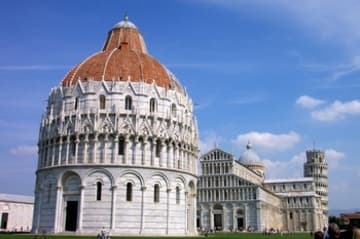
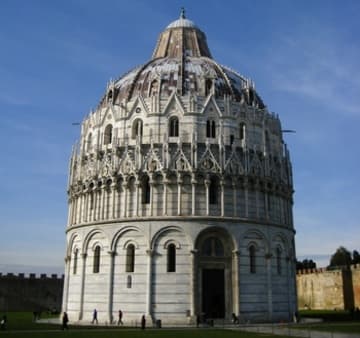
Italy's largest baptistery (54.86m tall and 104m in circumference), the Battistero di San Giovanni is also slightly taller than the Leaning Tower across the square. As it shares the same unstable ground as the tower, the baptistery also has a slight lean of 0.6 degrees towards the cathedral.
The lower register of the baptistery is 12th-century Romanesque (with round blind arches), while the upper parts are predominantly 13th-century Gothic (with pointed arches).
The exterior of the second register was decorated with statues and designs by Giovanni Pisano; most of these have been removed to the nearby Museo dell'Opera del Duomo and only a few have been replaced with copies.
The square main portal bears interesting reliefs by an unknown artist of the 13th century. The left side depicts the Labors of the Months while the right side portrays the Apostles (in pairs), the Harrowing of Hell, and King David.
The two-level architrave depicts the Life of St. John the Baptist (bottom) and Christ with the Virgin Mary, John the Baptist, the Four Evangelists, and Angels. On the archivolt, the 24 Elders of the Apocalypse flank the Lamb of God. The lunette contains a copy of Giovanni Pisano's Madonna, the original of which is in the Museo dell'Opera.
The other portal is also nicely decorated, including an architrave depicting the Annunciation and Saints.
The interior is fairly plain, dimly lit and not especially attractive, but it includes two great treasures: the first of the great Pisano pulpits and the large baptismal font in the center.
The baptistery's pulpit is a masterpiece carved in 1255-60 by Nicola Pisano. It was the prototype for a series of four monumental pulpits he created with his son Giovanni (the last, Giovanni's greatest work, is in Pisa's Duomo; the other two are in Pistoia and Siena).
The pulpit's high reliefs, which depict scenes from the life of Christ, are strongly influenced by classical art - including the Roman sarcophagi and Greek vase now in the Camposanto. Many of the figures look like pagan gods christianized as Madonnas and saints.
The central baptismal font was carved and inlaid in 1246 by the Gothic sculptor Guido Bigarelli da Como (active 1238-57). In the center of the font is a 20th-century statue of St. John the Baptist, to whom the baptistery is dedicated.
The baptistery is renowned for its perfect acoustics - choir concerts held inside can be heard from miles away. You can test the acoustics by arriving when it is least crowded (such as first thing in the morning), getting as close to the center as possible and sounding a loud note - it will echo around the room as it fades.
Highlights from Sacred Destinations
Highlights from Sacred Destinations
Advertisement
Advertisement
Advertisement
Where on earth