Highlights from Sacred Destinations
Explore the site
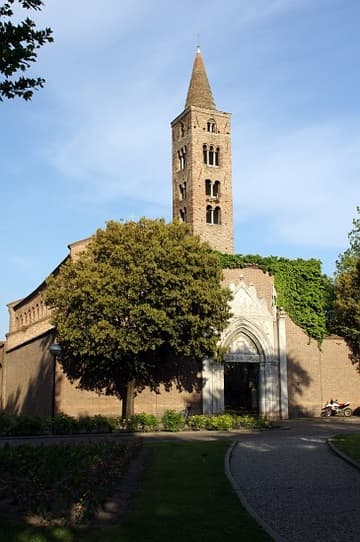
Entrance is through a 14th-century Gothic marble portal, which leads into a reconstructed brick atrium.
/ Italy / San Giovanni Evangelista
St. John the Evangelist · c. 426-30
Although much restored, this is one of the oldest monuments in Ravenna, dating from c.426-30 AD. Its chief attractions are its 5th-century architecture and 13th-century mosaics of the Crusades.
Although much restored, San Giovanni Evangelista is one of the oldest monuments in Ravenna, dating from c.426-30 AD. Its chief attractions are its fine 5th-century architecture and 13th-century mosaics depicting the Crusades.
San Giovanni Evangelista was commissioned by the empress Galla Placidia in fulfillment of a vow she made during a storm in 424 while sailing from Constantinople to Ravenna. She came to Ravenna to assume the government of the western Roman empire on behalf of her young son, Emperor Valentinian III.
In about 600 AD, the basilica was expanded by incorporating the narthex into the church and the interior was redecorated under Archbishop Marinianus (c.598-606). A mosaic fragment containing part of his name was found beneath the church. Further renovations were done throughout the Middle Ages and in the Baroque period.
In 1944, Allied bombs intended for the nearby train station completely destroyed the west facade and first four bays of the nave and badly damaged the apse and side aisles. It was rebuilt to its original form after the war and still contains many original elements.
San Giovanni Evangelista was commissioned by the empress Galla Placidia in fulfillment of a vow she made during a storm in 424 while sailing from Constantinople to Ravenna.
598-606).
Entrance is through a 14th-century Gothic marble portal, which leads into a reconstructed brick atrium. The west facade features a very tall arched porch, which was completely rebuilt after World War II. The square campanile (10th to 14th centuries) stands 139 feet high and contains two bells cast in 1208.
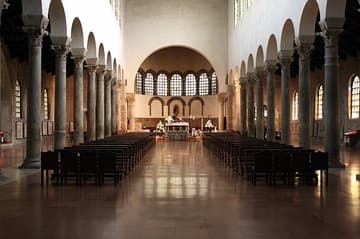
The spacious, brightly-lit interior is comprised of a central nave, side aisles, and an apse at the east end. Most of it was reconstructed after 1994 bomb damage, but many of the columns and their carved Byzantine capitals are original. The floor is now about 5 feet above its original level; it was periodically raised over the centuries to keep it above the rising waters of the marshy land.
The apse is round on the inside and polygonal on the outside, pierced with an unusual row of seven windows. Another three openings below the windows are now closed; scholars do not agree when this happened, but some maintain it was as early as the 5th century. Sadly, some very precious mosaics that once adorned the apse have been completely lost to "renovations" in the 16th century. They included portraits of most members of the imperial family of Theodosius and two depictions of St. John the Evangelist saving Galla Placidia from the storm at sea.
A significant amount of mosaics from the church do survive, however, from the pavement added in 1213 under Abbot Guglielmo. Now framed in sections and mounted on the side walls, the naive mosaics depict a range of fascinating subjects including mythical animals, scenes from medieval novels (such as a fox's funeral), and, most importantly, scenes from the Fourth Crusade (1204) including the taking of Zara and Constantinople.
A chapel in the left aisle retains some fragments of beautiful 14th-century frescoes on its vault, depicting the Four Evangelists with their symbols and four Doctors of the Church (Jerome, Ambrose, Augustine and Gregory). Some scholars have attributed the frescoes to Giotto, whose style they certainly reflect, but they were more likely painted by Giovanni Baronzio da Rimini.
The chapel at the end of the south aisle has a small 8th-century carved altar. There are interesting rectangular chambers at the end of both aisles, on either side of the east apse (not accessible). These have been traditionally described as a diaconian and prothesis, but in a 1990 study (see Sources), Janet Charlotte Smith makes a good case that they were actually a library and a scriptorium.
Highlights from Sacred Destinations
Highlights from Sacred Destinations
Advertisement
Advertisement
Advertisement
Where on earth