Highlights from Sacred Destinations
Explore the site
Modern steps lead down to the upper level of the prison, which is at the original ground level of ancient Rome.
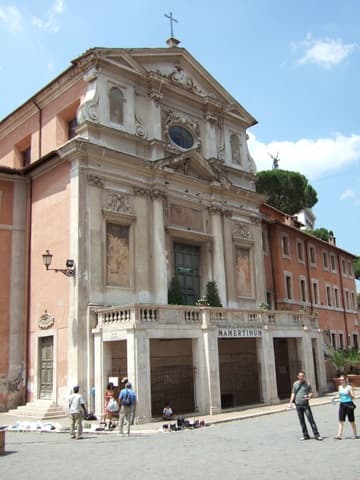
/ Italy / Mamertine Prison
Sacred site · 7th/6th C BCE
Located on the Capitoline Hill above the Forum, this ancient prison is where St. Peter and Paul are said to have been held before their execution in Rome.
The Mamertine Prison (a.k.a. Carcere Mamertino or San Pietro in Carcare) is an ancient prison at the foot of the Capitoline Hill in Rome.
The Mamertine Prison consists of two gloomy underground cells where Rome's vanquished enemies were imprisoned and usually died, of either starvation or strangulation. Famous prisoners here include the Goth Jugurtha, the indomitable Gaul Vercingetorix and, according to legend, St. Peter.
There is no archaeological evidence or early written account that Peter was here, but the legend had taken root by the 5th century and the prison attracted early pilgrims. It remains a pilgrimage site today and a church, San Giuseppe dei Falegnami, now stands over the prison.
The Mamertime Prison is mentioned by several ancient writers, including Livy, who dated its construction to the 7th century BC under King Ancus:
The lower room of the remaining part is known as the Tullianum after its builder Servius Tullius (6th century BC). This part served as a place not of punishment but of detention and execution for condemned criminals. The ancient historian Sallust said it was 12 feet below the ground and "neglect, darkness and stench make it hideous and fearsome to behold."
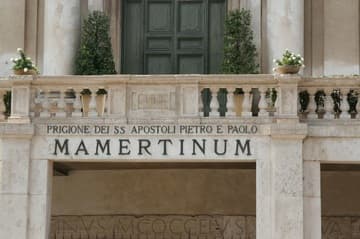
The prison was in use until at least the late 4th century AD, when it was mentioned by the historian Ammianus Marcellinus. After the prison ceased to be used for its original purpose, it became a pilgrim site and accumulated various legends. It later became known as Mamertinus.
In the 16th century, the church of San Guiseppe dei Falegnami was built above the prison.
Modern steps lead down to the upper level of the prison, which is at the original ground level of ancient Rome. The doorway is modern.
The upper room of the prison is trapezoidal in shape and dates from the 2nd century BC. The walls are made of blocks of tufa and bears a plaque on the right naming the more famous prisoners, listing how and when each one died. A second plaque names the martyrs and saints who were held here with the names of their persecutors, and the notable visitors who came here on pilgrimage. In the back is an altar with the busts of Saints Peter and Paul.
The lower room was originally accessed through a round opening in the floor of the upper room, which is now covered with a grate. Today, access is by means of a modern staircase on the left. At the top, look for a stone said to have the imprint of St. Peter's head from when he was hurled down into the prison.
The lower room, the Tullianum, is circular and made of blocks of peperino held together without mortar. This was the most inner and secret part of the larger complex, and here the condemned were thrown and usually strangled.
Here there is a small altar, topped with a relief of St. Peter baptizing his fellow prisoners. The upside- down cross on the red marble front lends the desolate place an extra-sinister air, but that's the Cross of St. Peter, who was crucified upside down.
To the left of the altar is a column to which both Peter and Paul were tied and from there they converted their guards to Christianity.
A round opening in the floor next to the altar provides access to a spring which has surfaces in the floor since Classical times: this is the one that Peter is said to have miraculously created for baptism and which pilgrims have long believed to have healing properties.
Highlights from Sacred Destinations
Highlights from Sacred Destinations
Advertisement
Advertisement
Advertisement
Where on earth