Highlights from Sacred Destinations
Explore the site
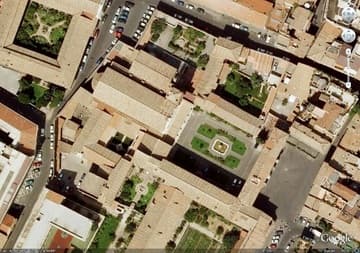
Santa Cecilia is a basilica church with no transept and a north tower.
/ Italy / Santa Cecilia in Trastevere
St. Cecilia · c. 820
This church and active convent was built in the 9th century over the house of St. Cecilia, a 3rd-century martyr. It has a Byzantine apse mosaic upstairs and Roman excavations below.
The church and convent of Santa Cecilia in Trastavere in Rome was built over the home of St. Cecilia, an upper-class woman who owned a house on this site and was martyred in the 3rd century. Her body was found incorrupt in 1599, complete with deep axe cuts in her neck; a statue under the altar depicts the way it was found. Excavations of Cecilia's Roman house can be toured underneath the church.
It has been difficult to determine the dates of Cecilia's life and death, but a few historical details given in early accounts provide a general range of 175 to 250 AD. The first account of Cecilia's martyrdom (from which the story above derives) was written in the middle of the 5th century; like most narratives of this period it is very much embellished. The Catholic Encyclopedia calls it a "pious romance."
Legend aside, Cecilia certainly seems to be a historical figure. She was a patrician woman who owned a house (domus) in Trastevere, in which she founded a church (titulus). Archaeological evidence shows there was a 2nd-century house on the site and that it was used for Christian worship by the 5th century. An early 5th-century document mentions a titulus of "Romae Transtibere, Caecili." Cecilia was buried in the Catacomb of San Callisto near the Crypt of the Popes, while Valerian and Tibertius were buried in the Catacomb of Pretestato.
The present church was built over the ruins of Cecilia's house by Pope Paschal I (817-24). The body of Cecilia (said to be found incorrupt) and those of Valerian, Tibertius and Maximus were exhumed from their original burial places and enshrined in the new church.
During a restoration of the church in 1599, Cecilia was exhumed again, and again she was found incorrupt, with three cuts in her neck. The exhumation was carried out in front of several witnesses, include a sculptor who made a statue of her body as he saw it (more on this below).
The church's facade was added by Ferdinando Fuga in 1725 and more renovations were done in 1823, including enclosing the nave columns inside piers. The ancient Roman buildings beneath the church were excavated and too-creatively restored in 1897. The church was restored again in 1990.
It has been difficult to determine the dates of Cecilia's life and death, but a few historical details given in early accounts provide a general range of 175 to 250 AD.
It has been difficult to determine the dates of Cecilia's life and death, but a few historical details given in early accounts provide a general range of 175 to 250 AD.
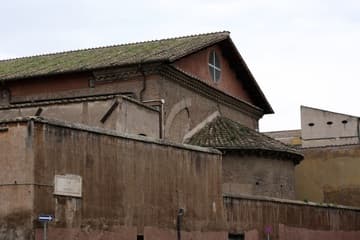
Santa Cecilia is a basilica church with no transept and a north tower. It is oriented west, in accordance with Roman tradition. The entire brick exterior of the 9th-century building survives intact, but most if it is difficult to see because of later additions.
Entrance is through a small courtyard to the east, whose fountain incorporates a Roman cantharus urn. The portico or narthex includes a 13th-century architrave and various inscriptions and architectural fragments.
Inside, there is a nave with side aisles and several side chapels. Some of the original architecture has been disguised by 19th-century renovations, the most dramatic (and unfortunate) of which is enclosing the original columns within piers. The choir at the west end is raised, with a crypt containing Cecilia's tomb beneath.
A side chapel at the back/east of the right/north aisle is part of the 9th-century church. The only chapel included in the original basilica, it was built above the bathhouse in which Cecilia traditionally suffered. More chapels were added to the same aisle later, including a Chapel of the Relics in the 15th century.
Notable artworks in the church include The Last Judgment by Pietro Cavallini (c. 1293) and a baldachino by Arnolfo di Cambio over the altar (late 1200s).
In front of the choir is a moving sculpture by Stefano Maderno of Cecilia's incorrupt body as it was found when exhumed in 1599. Contorted and yet somehow graceful, the statue is highly unusual and has great emotional impact.
The pavement in front of the statue contains a round marble slab with an inscription of the artist's statement, made under oath, that Cecilia's body was found incorrupt:
The apse above the choir is decorated with a fine 9th-century mosaic on the theme of the Second Coming, which is quite similar to the one at Santa Prassede. It consists of seven standing figures - Christ in the center flanked by three saints on each side - against a background of a meadow with flowers, palm trees and sunset-lit clouds.
At the top of the triumphal arch is the monogram of Pope Paschal I, who built the church. Paschal also appears on the left of the mosaic, with a square nimbus indicating he was alive at the time it was made. Above his head is a small phoenix, symbol of resurrection, and next to him are St. Paul and St. Agatha. Christ is in the center, his left hand holding a scroll and his right hand raised in blessing. Above him is the Hand of God. On the right stand St. Peter, St. Valerian (Cecilia's husband) and St. Cecilia. Peter holds his keys and the latter two hold martyrs' crowns.
Beneath the figures are common elements in Roman mosaics: 12 sheep representing the apostles, the Lamb of God, and the holy cities of Bethlehem and Jerusalem on either side.
At the bottom, a rather lengthy inscription in gold reads:
The left aisle near the entrance contains the sacristy, which serves as the entrance to the excavations beneath the church. Down here are the ruins of two ancient Roman houses, with mosaic pavements, Early Christian sarcophagi and a small museum. Eight cylindrical towers are believed to be part of a tannery, and there is a pagan household shrine with a relief of Minerva.
A modern crypt, built in 1899-1901, is at the west end of the excavations. Behind an iron grille in the crypt is the 9th-century confessio containing the tombs of the martyrs Cecilia, Valerian, Tibertius, and Maximus and the popes Urban I (222-30) and Lucius I (253-54). Behind that is the original crypt directly beneath the choir. Unfortunately none of its 9th-century decoration has survived.
Highlights from Sacred Destinations
Highlights from Sacred Destinations
Advertisement
Advertisement
Advertisement
Where on earth