Highlights from Sacred Destinations
Explore the site
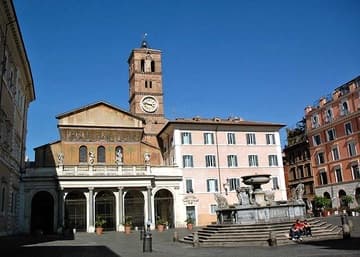
The octagonal fountain in the piazza is an ancient Roman original that was restored and embellished in the 17th century by Carlo Fontana.
/ Italy / Santa Maria in Trastevere
Sacred site · rebuilt c. 740
This church is held to be the first place of Christian worship in Rome, built where a fountain of oil sprung up on the day of Christ's birth. Inside are many excellent mosaics.
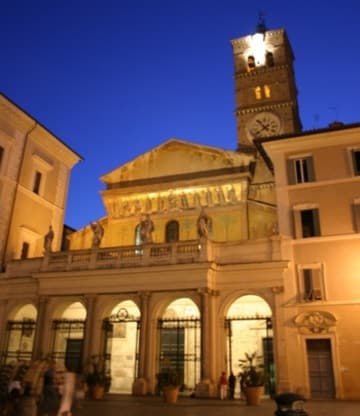
Dating from the 4th century AD, Santa Maria in Trastevere has a long history and dazzling 12th-century mosaics that make it well worth a visit. Located in the popular Trastevere neighborhood, its atmospheric piazza is enhanced by the mosaics on the façade, especially at night when the church and its tower are illuminated.
Santa Maria in Trastevere may have originally been founded as early as the 3rd century by Pope Callixtus (217-22), but it was probably built around 350 AD under Pope Julius I (337-52). In this early period the church was known as titulus Callisti. It was partially destroyed by fire during the sack of Rome in 410, then repaired and rededicated to the Virgin Mary by Pope Celestine (422-32).
Restoration was undertaken by Pope Hadrian I (772-95), then Pope Gregory IV (827-44) added a crypt to hold the bodies of the popes Calixtus, Julius I and Cornelius that had been exhumed from the catacombs. Renovations of the apse took place under Pope Leo IV (847-55) and Benedict III (855-58).
The church was totally rebuilt in the 12th century by Pope Innocent II (1130-43), using materials from the ancient Baths of Caracalla. Most of the present building dates from this era, with the portico and some other remodelling from the 19th century.
Santa Maria in Trastevere may have originally been founded as early as the 3rd century by Pope Callixtus (217-22), but it was probably built around 350 AD under Pope Julius I (337-52).
Santa Maria in Trastevere may have originally been founded as early as the 3rd century by Pope Callixtus (217-22), but it was probably built around 350 AD under Pope Julius I (337-52).
The octagonal fountain in the piazza is an ancient Roman original that was restored and embellished in the 17th century by Carlo Fontana. In the evenings, the fountain is a popular gathering place for locals. Off the north side of the piazza, a little street is named Via delle Fonte dell'Olio in honor of the oil miracle.
The façade was restored by Carlo Fontana in the 17th century, but its faded mosaics date from the 12th or 13th centuries. The portico is a 19th-century addition; displayed inside are fragments from the earlier churches, dating from the 4th to 9th centuries. They were found during excavations beneath the 12th-century floor of the church.
Inside the church are 22 granite columns taken from the ruins of ancient Roman buildings. A Cosmati column to the right of the altar with the inscription FONS OLEI marks the spot of the miraculous flow of oil.
The restored mosaics on the apse vault and triumphal arch date from around 1140. The triumphal arch depicts the Four Evangelists, the prophets Isaiah and Jeremiah, caged birds representing sin, seven candlesticks, and a Christogram (chi-rho). The apse vault shows the Coronation of the Virgin with saints and Pope Innocent II holding a model of the church.
The six mosaic panels lower on the apse (between the windows) were made by Pietro Cavallini on the subject of the Life of the Virgin in 1291. In the Nativity scene, note the little building just under the figure of Mary with a stream of oil flowing from it.
Left of the altar is the Altemps Chapel (1588) with Baroque decoration. One of the frescoes depicts the Council of Nicea. Another notable artwork is a fresco by Domenichino of the Assumption of the Virgin.
The church keeps a relic of Saint Apollonia (her head) and a portion of the Holy Sponge. Among the burials in the church are Pope Callixtus I and Lorenzo Cardinal Campeggio.
Highlights from Sacred Destinations
Highlights from Sacred Destinations
Advertisement
Advertisement
Advertisement
Where on earth