Highlights from Sacred Destinations
Explore the site
The church stands on the very crest of the Celian hill, in an area that was mostly uninhabited from ancient times until recently.
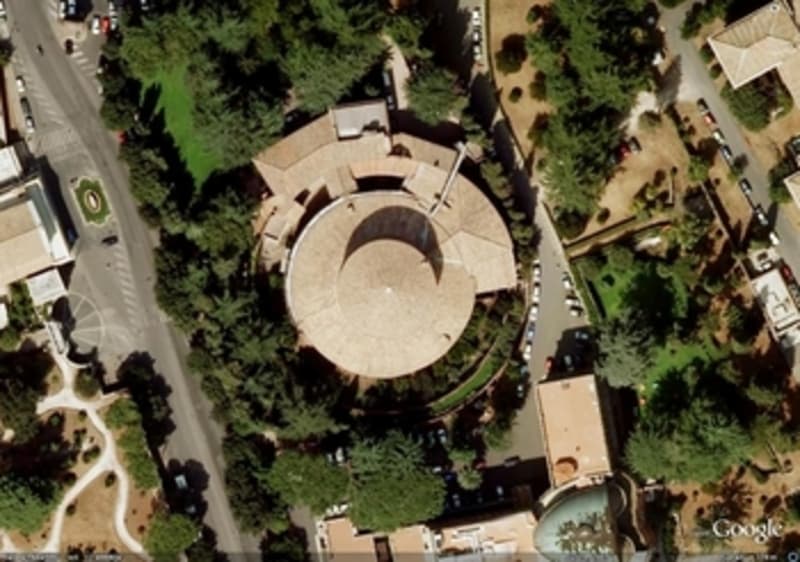
/ Italy / Santo Stefano Rotondo
St. Stephen · c. 470
Dedicated to St. Stephen, the first martyr, this is one of the largest and oldest round churches in existence. Dating from the 5th century, it reflects local and foreign influences.
Santo Stefano Rotondo (sometimes called San Stefano Rotondo) in Rome is one of the largest and oldest round churches in existence. Dating from the 5th century, it is a fascinating church that reflects both local and foreign influences.
Santo Stefano Rotondo was built by Pope Simplicius I (468-83) and dedicated to St. Stephen, the first martyr (Acts 6-7).
St. Stephen's relics were reportedly found in Jerusalem in 415 and the cult of the proto-martyr had come to Rome by the mid-5th century. Pope Leo I (440-61) had already dedicated two churches to Stephen in Rome by the time this one was built.
Stefano Rotondo was built on the former site of a Roman military barracks for non-Italian soldiers called the Castra Pergrinorum. The barracks were abandoned in the 4th century and destroyed in the 5th century in order to build the church.
The church was renovated in the 6th and 7th centuries, when Pope Theodore I (642-49) transferred the relics of Sts. Primus and Felicianus here from their catacomb on Via Nomentana.
It was later restored by Pope Hadrian I (772-95) and again in the 12th century, when the Lateran Palace tried to attract people back to the area. The entrance portico was added under Pope Innocent II (1130‑43).
Sadly the design was radically altered in 1450, when the outer wall and three arms of its Greek cross plan were pulled down. Nevertheless, the core of the original church remains fully intact.
The church is currently undergoing extensive restoration (or at least it was when this author visited in July 2006).
Stephen's relics were reportedly found in Jerusalem in 415 and the cult of the proto-martyr had come to Rome by the mid-5th century.
Pope Leo I (440-61) had already dedicated two churches to Stephen in Rome by the time this one was built.
The church stands on the very crest of the Celian hill, in an area that was mostly uninhabited from ancient times until recently. A visitor to the church in 1828 recorded only vineyards and scattered farms in the area. The church is located opposite Santa Maria in Domnica but its entrance is on Via di Santo Stefano Rotondo, off the main road and through a brick gateway.
The round design of Santo Stefano Rotondo is very different from that of a traditional western church. Its only parallels are in the martyrea of the 4th through 6th centuries in the East. The most famous example is the Rotunda over the tomb of Christ in Jerusalem, built by Constantine.
These round buildings were constructed specifically for the worship of individual martyrs and were themselves inspired by the design of imperial mausolea as well as pagan heroons (for the worship of semi-divine heroes). Unusually, given its design, there is no evidence that a relic of St. Stephen or other martyr was ever kept in St. Stefano Rotondo.
The original plan of the church consisted of three concentric circles, intersected by the four arms of a Greek cross (+). The arms divided the outer ring into eight sections: four chapels plus four covered areas used as an entrance to the church and passageway to the chapels.
Traces of the three chapels torn down with the outer ring in 1450 can be seen in the current outer wall by walking through the surrounding garden. Looking up at the clerestory you can see some Carolingian brickwork and scaffold holes from Pope Hadrian I's repairs.
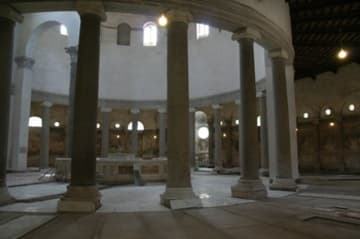
The two inner rings were (and still are), made of arcaded colonnades forming a circular aisle and central nave. The interior was once brightly lit by 22 windows in the clerestory wall; all but 8 of these are now bricked up. The columns are a mix of Roman spoils and Early Christian originals; the Corinthian-style capitals were specially made, with crosses part of the design.
The present entrance to the church is through an original doorway that leads into the one remaining arm of the Greek cross plan. This contains its original 5th-century chapel, where Pope Theodore added an altar with the relics of Primus and Felicianus along with an apse and mosaic in the 7th century. The chapel also contains a Roman throne said to have been used by Pope Gregory the Great (590-604).
The mosaic depicts a large jewelled cross, flanked by the two martyrs and surmounted by a roundel with a bust of Christ. This is another parallel with the Rotunda of the Church of the Holy Sepulchre, which had a similar jewelled cross. Its inscription reads:
The main body of the church has marble pavement from the 16th century, which lies 0.38 meters above the original floor level. (I believe the current restoration works are uncovering the original Early Christian floor.)
The altar in the center of the church was placed by Pope Gregory XIII (1572-85), who also ordered the frescoes on the outer arcade walls. Depicting a variety of martyrdoms to reflect the church's dedication to the proto-martyr Stephen, they were painted by Antonio Tempesta and Niccolo Circignani.
Charles Dickens was shocked by the violence of the martyrdom frescoes, as he memorably recorded in Ch. 10 of his Pictures from Italy (1846):
Highlights from Sacred Destinations
Highlights from Sacred Destinations
Advertisement
Advertisement
Advertisement
Where on earth