Highlights from Sacred Destinations
Explore the site
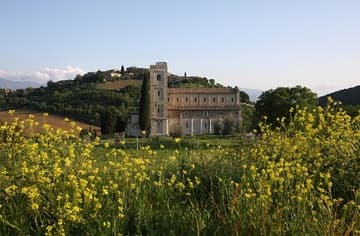
An elegant Romanesque edifice standing peacefully in a beautiful Tuscan valley, the Abbey of Sant'Antimo is surely one of the most beautiful in Italy.
/ Italy / Sant'Antimo Abbey
St. Antimo · 1118
Located in a Tuscan valley near Siena, this spectacularly beautiful abbey is a must-see. Gregorian chant can be heard from inside the elegant Romanesque church throughout the day.
Located in a Tuscan valley not far from Siena, the spectacularly beautiful Sant'Antimo Abbey is a must-see for anyone visiting the area. Originally built in Carolingian times, the present abbey church is an elegant Romanesque edifice of the early 12th century. Gregorian chant can be heard from inside throughout the day.
In Roman times, a villa stood on this beautiful site in the valley of the River Starcia. Remnants from the villa were reused in the church and can still be seen in the tower. An ancient inscription discovered on the site indicates there was a sacred spring here as well.
According to legend, the abbey was founded by Charlemagne in 781 after he fell ill nearby and prayed for deliverance. Unfortunately there is no evidence for this popular tale, but Charlemagne did stop by that year (apparently in full health). Although he did not found the monastery, which had already been under construction since 770, he set his seal on the foundation.
The monastery begun in 770 was ordered by the Lombards, who ruled the region at that time. Built over an ancient martyrium to St. Antimo, the monastery would serve as a rest stop for pilgrims, merchants, soldiers and government officials traveling the busy Via Francigena that connected Rome to France. On December 29, 814, Loius the Pious (son of Charlemagne) issued a charter providing Sant'Antimo abbey with gifts and privileges.
The church was rebuilt in the early 12th century in a Romanesque style inspired by Lombard and French forms. The date 1118 is inscribed on a column in the ambulatory.
The Abbey of Sant'Antimo was suppressed by Pope Pius II in 1462 and the church was given to the bishop of Montalcino. It is now administered by about six Canons Regular, who conduct services with Gregorian chant at the altar throughout the day.
Although he did not found the monastery, which had already been under construction since 770, he set his seal on the foundation.
According to legend, the abbey was founded by Charlemagne in 781 after he fell ill nearby and prayed for deliverance.
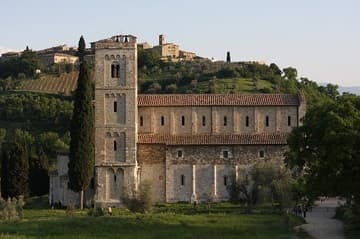
An elegant Romanesque edifice standing peacefully in a beautiful Tuscan valley, the Abbey of Sant'Antimo is surely one of the most beautiful in Italy. Its harmonious architecture dates from the early 12th century and shows French and Lombard influences. These somewhat remote influences are explained by the area's one-time ruled by Lombards and its location on the Via Francigena leading to France. A single tall tree stands next to the square bell tower on the north side.
Surviving from the original 8th-century monastery church is the Carolingian chapel, with its small apse next to the main 12th-century apses. The chapel is now used as a sacristy and is not open to visitors. Also not normally accessible is the Carolingian crypt beneath the present church, which has an apse at each end. A third survivor of the 8th century can be seen in the pretty ruined cloister: three round-headed bays of the chapter house.
The cloister area contains a 16th-century cistern standing on the site of the medieval well. The south portal, framed with reliefs of foliage, geometrical designs and mythological animals, dates from the 10th century. The church is entered via the west portal, with decorations and lion statues of the 12th century.
Inside, the layout is that of a typical pilgrimage church, with nave, side aisles, raised presbytery, ambulatory and small crypt. Interesting sculptures adorn many of the capitals. In the ambulatory are some frescoes, attributed to Spinello Aretino (15th century) or an artist associated with Taddeo di Bartolo (14th-15th centuries). They depict a saintly pope (perhaps Gregory the Great) and a martyr saint (probably Sebastian).
Highlights from Sacred Destinations
Highlights from Sacred Destinations
Advertisement
Advertisement
Advertisement
Where on earth