Highlights from Sacred Destinations
Explore the site
The crypt is rectangular, bare and of little architectural interest, but that is all the better to appreciate what remains of a magnificent fresco cycle painted c.
/ Italy / Siena Crypt
Sacred site · 1270-80
This recently-discovered room beneath the Duomo has a wonderful series of 13th-century frescoes adorning its walls.
The Crypt (Cripta in Italian) beneath the Duomo in Siena is a newly discovered gem with a wonderful series of 13th-century frescoes adorning its walls.
Despite its name and location, the Cripta is not exactly a crypt - it was never used for burials. It is thought to have functioned as a sort of porch, with stairways leading directly up into the nave of the cathedral.
It was constructed at the same time as the Duomo - in the 13th century - but Siena's citizens barely got a chance to enjoy its frescoes before it was filled with debris and abandoned.
Expansion work on the choir beginning in 1317 required dismantling the crypt's vault, while the construction of the baptistery soon destroyed the facade. The crypt was subsequently used as a storeroom for construction materials and closed up for good.
It lay unseen for nearly 700 years until its re-discovery during routine excavations in the Duomo in 1999. The room opened to the public in the fall of 2003.
It lay unseen for nearly 700 years until its re-discovery during routine excavations in the Duomo in 1999.
Expansion work on the choir beginning in 1317 required dismantling the crypt's vault, while the construction of the baptistery soon destroyed the facade.
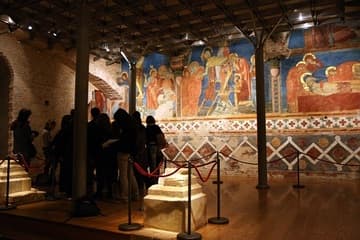
The crypt is rectangular, bare and of little architectural interest, but that is all the better to appreciate what remains of a magnificent fresco cycle painted c.1270-80.
Originally, there was a full cycle of Old Testament stories along the top of the wall and a parallel cycle of New Testament stories below. Sadly, the former have been lost due to the destruction of the vault.
Among the scenes that remain are the Annunciation, Visitation, Nativity, Kiss of Judas, Crucifixion, Deposition, and Entombment of Christ. The frescoes are in vibrant colors (primarily red, blue and gold) and full of feeling.
The artists are not known for certain, but probably included Dietisalvi di Speme, Guido di Graziano and Rinaldo da Siena. They were most likely assisted by a young Duccio di Buoninsegna.
Highlights from Sacred Destinations
Highlights from Sacred Destinations
Advertisement
Advertisement
Advertisement
Where on earth